Captain Bill Robertson
Switzerland, 30 June 1990
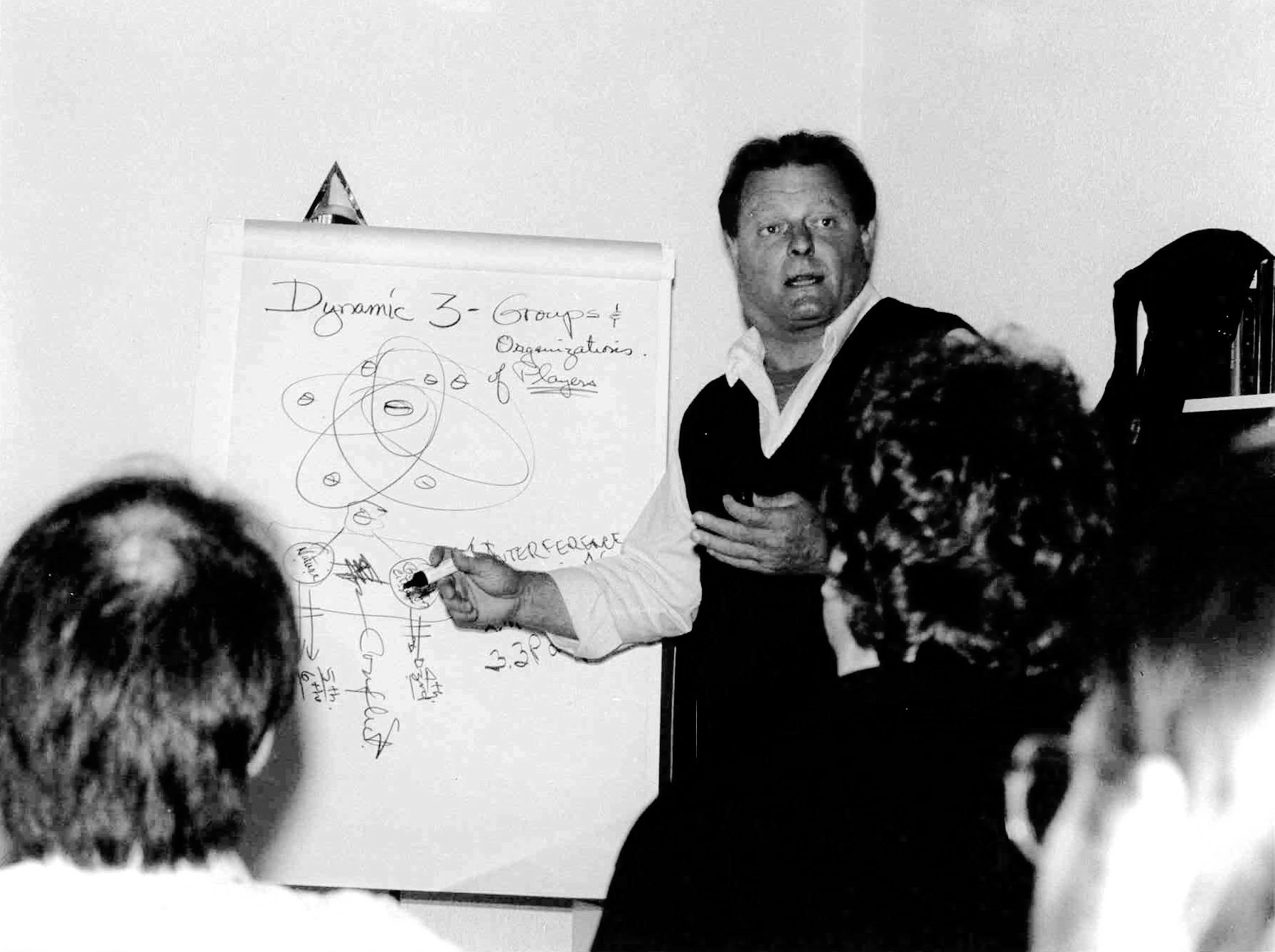
Thank you very much!
Life is basically a game. LRH said that many years ago. And it is just in the last few years, as we progress through the Bridge, the upper levels of the Bridge, we realise more exactly what he’s talking about.
So, this is.. we’re going to this time do a Dynamics Lecture, probably like you’ve never heard before. We’re going to start from the top, and work down. And we’re going to start with the idea of games, and then twelve dynamics, all the way down to your first dynamic.
(writes on board)
Life is Basically a Game.
Okay, I just wrote it again: Life is basically a game. Okay, Now, what are the dynamics, then? Did you ever look at it as, they are different parts of the game, different activity areas in the game? You see, the game we are playing in life is very complex. We, as players, you might find, are very simple. We are not complicated ourselves, specially when you go up the bridge and take off all the complexities. But the game is very complicated. And that is why LRH started giving us all the basics of the game to help us understand what it was we were doing. Because many people do not believe that life is a game. They think there are games in life... but life is very serious. You know, there are games like the World Cup in Italy, or water skiing on the lake, or riding bicycles — especially when they are racing, you know — and some people consider their vacation time a game, and they go out and play and different things and they come back to work and real life, and... hahaha!
So what are the things... why don’t people see life as a game? You see? That’s what we want to first get that straight. Because a thetan or a Source of making things, or a person, being, who wants to play a game, they want basically three things from a game:
(writes on board)
1. FUN
He wants fun in a game! And we will define that a little more in just a moment.
2. WINS
In other words, after the fun, there should be some wins in the game. You don’t lose all the time.
3. ACCEPTANCES
This means recognition and communication and involvement with other players, by other players. Now, that’s important. That one, number three, tells you that a game has more than one player in it. You have probably met people who are very lonely in life. They don’t have any terminals. And you, if you ask them they’re probably not having much fun, and they’re probably not having much wins either. See, nobody accepts them even as a player, or as a potential player. So, it sort of all goes together in a big game, what the player wants out of it. So, you can see, now, why people don’t think life is a game.
Take the living conditions, in, well, you have been briefed on Romania, I think, in Romania in the past thirty or forty years, I mean, they had one Securitate over every sixteen people, in the whole country. So, they couldn’t have a lecture like this. There’d be at least four Securitate in here. And the whole rest of them would be on their way to shut us down. Hahahaha! Because we are talking of freedom and things like that. And fun! And fun. Hahaha! So you couldn’t have much fun in Romania. And of course they didn’t have many wins, because the government was taking everything away from them. They couldn’t even have havingness. And they weren't accepted as citizens, they were more accepted as slaves. They had to do what the government wanted them to do.
So, without this, very little... well they were accepted because maybe they could have children for the Securitate, or because they could work at a job every day and not get much to eat, but even if they had the fun of having a child, they probably couldn’t support it, so it wasn't much fun after that.
And we know from the aid programmes that have been done by the Free Zone that the people were having more wins than they’d had in forty years just by receiving a box with food and clothes and stuff in it, or medicines. So, you might ask, well, you see why they don’t consider it a game! Each one is a thetan, each person running a body there is a thetan, but he’s not getting this, so he doesn’t consider it’s a game. Now, they might have had their little smaller games going on in between, and some little acceptances in the community or between families – how to beat the Securitate, how to find the bugs in the apartment – you know, things like that.
Because, you see, the problem is that so many people have case on this planet, that they can’t get out of a game, you know, if they want to. You see, there is a protective mechanism on all of these games, originally, called the rights of a thetan. LRH talks about these in the PDC:
(writes on board)
1. The right to your own sanity
2. The right to leave a game (or not leave a game)
3. The right to make or choose (or not make or choose) a game.
So he has a right... we found these on the upper levels, you know – also just like LRH said, they’re there. They are there in the games structure. He has a right to his own sanity, and the right to leave a game.
But, unfortunately, there has been a lot of interference in the overall game of life, which helped produce a lot of the case, which we call case or bank – didn’t produce it all, but helped! – and the thetan got so enturbulated that he didn’t have his own sanity, and therefore he couldn’t, didn’t know how to exteriorise, or leave the game! So the only other choice he had was to stay in it and try to change it if he could, which of course they call in the eastern countries, revolution! Here they just call it protest, or voting for something else, or what, but in the East Block there was all, oh, revolution! Boom!
Okay, so you can see that a great many people also in the west do not consider life as a game. They may have too many economic scenarios on them, they haven’t evaluated where these are coming from, so they just walk right into them, or their best advisers and authorities are also, shall we say, part of the scenario and they tell them what’s best for them, and that doesn’t help them at all.
Now this happens a lot in education, in medicine, in government, in politics, and economics. What are they dramatising? They’re dramatising a lot of false datums put into the game by the same people who are interfering with it. Remember, the dynamics are an agreement. Everyone agreed, when they started this game, to play with these areas of life. But, if interference comes in – now, interference we’re defining here as things coming into the game not agreed to by the players at all, when they started the game.
So, let’s take an example. Suppose they’re playing the World Cup. In Italy, two football teams. Okay? Now everybody’s agreed that they’re supposed to come on, they play for ninety minutes, they follow the rules. The players have agreed, they have umpires there, they have people watching them, they all know the rules. They break the rules, the umpire... peeep! Yellow card, ach! Everybody agrees, okay, that’s all right, now start... he’s penalised, you see?
Now, interference would be something like this. The manager of one team, let’s say, he’s got hatted, he has interference on his track by the implanters. So he decides the way to win the game is to put some slow-acting poison in the lemonade drinks of the other team. So they play all right for about half an hour and then they start falling down on the field, you see? Hahaha! And so his team will win, you see? Or maybe the other manager also has some track with this kind of interference in games. And he decides that he wants to put assassins up in the crowd in the high stadium, and when they’re screaming about something on the field, they shoot members of the other team. Now you can imagine what’s going to happen: man, the fans are going to be totally mad at everybody, and there’s going to be fights and there’s going to be total confusion, and newspaper stories, and everything. The game has been interfered with.
And that is exactly what has happened in life in the track of the game which has caused people or thetans to believe that they’re having no fun and they’re having no wins. Now, it is a complex series of interferences, not just simple things like I just talked about. It is built up over the years, over the centuries, over lifetimes. In all fields: philosophy, education, science. I mean, how many of you know that you have experience of a past life, for instance? I mean, most of you have experienced that in auditing. You know darned well, yes, I was doing things back there on the track. Everyone comes to this sooner or later in their auditing.
And in science, they don’t believe that at all! You see? And everyone believes in – well, not everyone, but a lot of people believe – that you should have to work for somebody else, and you should have to pay so much of your money for all these taxes that are happening in other countries. Maybe here too! And they know this is true, because otherwise, oh my goodness, we’d probably be attacked, invaded, everything would fall apart. But I know some countries don’t have any taxes. And it works okay there. People are happy. They have fun, they have wins. And they have money in their pocket. Hahaha!
Well, how complex is the game? Let’s go back to that now. We know it’s a game, and we know what people want out of it, and we know that it can be interfered with. Okay? So we know that some people will not consider it to be a game, because they’re not having enough fun and wins and acceptance.
(writes on board)
1. Fun
2. Wins
3. Acceptance
Okay, let’s see what involves people in a game in the first place.
(writes on board)
1. Intelligence
2. Interest
3. Improvement
The game must have certain qualities to get people to join it in the first place. It must be interesting, it must provide some use of the intelligence, the logic, and it must have some way to improve the play, improve toward a win, or improve toward some kind of a goal. Now, I’ll give you an example of this, and you could probably just use these three things and make us a game, a new game into the society and make a million dollars off of it if you use this properly.
Let’s take an example, right? You have a game where one guy comes to another and says: "I’ve got a game for you." The other guy says: "Oh!" So gets a little interest, see? He says: "What is it?" So, the guy tells him: "Okay, you hold this stone in your hand here, and then you move your hand quickly and the stone falls down." The guy does that, and the stone does fall down, see? And you think: "What do you do next?" Well, you pick up the stone, you hold it in your hand, and you move your hand quickly and the stone falls down.
Now, a person with intelligence is only going to do this two times. There’s no way to improve it unless you go to another planet. I mean, Newton used that game, obviously, to discover the laws of gravity. But that was an application of intelligence, very much intelligence, because there’s no improvement just letting the stone fall. So he became disinterested in the game and just got interested in why did the stone fall! Hahaha! Okay, but you can see that. That would get boring after a while.
The same with little baby toys. You know, you have a doll, you pull a string back and it goes: "Mama! Mama!" You give it to the baby. Baby finds the string. Pulls it, he goes: "Mama! Mama!" Lot of interest from the baby! For about five or ten minutes. You hear, "Mama! Mama! Mama! Mama! Mama!" The next thing you hear is the baby throwing its doll out of the crib! Hahahaha! Most people they try to, "Hey, you threw your doll out of the crib, you know, here, remember the string...?" They haven’t realised that the kid has already played that game to the level of interest, improvement, and his intelligence is ready for something else. Now, the toy manufacturers have gotten gradients in on that, and they’ve put more intelligence in the dolls, and you know, you squeeze them, and they say different things, they have a computer tape in there now, and they say different things. You see, what they had to do, they had to increase the complexity of it, make it more interesting, more intelligence in it, more chance for improved communications to come out of it, so that the kids can stay interested longer, play the game longer, be involved in the game.
Okay, Now let’s go back to the rock. Suppose you had an inflatable ball there, and you told the guy the next gradient is to now throw it through that hoop up there. So now he has some chance for improvement. He can try to get the ball through the hoop, and judge how to do that. And finally, he can do that from all kinds of locations. He can put the ball through the hoop, and he’s tired of the game. But now let’s suppose that you say: "Okay, well, let’s have four guys with you and you can throw the ball around and put it through the hoop, and five guys on the other side to try and keep you from getting it through the hoop, and they have a hoop down here, and they try to get it through their hoop. And we have it all in a specified time, and we have rules. And then, if you break the rules, you have a free shot through the hoop."
What have we got? Basketball. And that sport, that game, they have many teams and series in America. It’s one of the major sports. And it’s spreading to the European area. In Spain they show it every day on television. And not only that, they get people to just come and watch it, not even to play it! So they even get acceptance from playing it. So they have fun, they get wins, and they get acceptance. And when they get professional, the wins is replaced and equals by exchange by money. And the people pay to come and see it. So you see how you can improve or make more complicated, a game that is very simple, and come up with something that makes millions! Very interesting. These are the basics. These are the basics.
Now, as we said before, however, the game can go bad and you don't think it’s a game any more, if you get interference, which just means a non-agreed upon intrusion into the game. For instance, in a basketball game, with all the crowd in there, suddenly the roof falls down. Boom! Or the people are coming back from holiday, and the bus rolls over. See, it’s no fun any more. It’s not a game. Okay. So, people have had so many losses, and so little fun in life, that they don't consider it a game any more.
Now, we come to the dynamics. The dynamics are the various parts of life on or in or with which you can play parts of the game in the big game of life. How complex is this game? Well, we have a figure, from doing the Bridge that there’s something like ten to the forty-one power players in the game. That’s ten here, with forty-one zeros behind. That’s a very complex game.
(writes on board)
1041 = 100,000,000,000,000,000,000,000,000,000,000,000,000,000
You see the thing here that says one million galaxies. That’s only ten to the six. And they even say down at the end here that there may be a hundred million galaxies. And if there’s a billion life-sustaining planets in each galaxy – a billion! – and, that’s planets, if there’s four or five billion people on each planet – let’s say ten billion, what the hell – so that’s ten billion, and that’s ten to the seventeen planets, just in this group, and there’s ten to the twenty-seven people... you see, there’s much more that that in the game! Much more! We’re only up to twenty-seven. Let’s say that’s only one-tenth of the sky that they can cover. Okay, that makes it only ten to the twenty-eight. And let’s say a lot of the beings don't even have bodies, and they’re around. Let’s say another... ah... billion billion. A million billion, say. Well, actually, that’s not right, because I’m multiplying. That should be added, because we didn't say they should be multiplied, we just said added. So that would be not even ten to the twenty-nine. Something a little bit less.
Okay, so, we got a game here which is very complex. There are many more inhabited galaxies, many more players, many more inhabited planets than you would suppose. Now, in a game that size, what are we doing in it? In the upper levels we have come to the conclusion that we wouldn’t have played this game unless we were ready for it. Now that shows you the incredible amount of intelligence or use of logic in playing a game, the interest, the improvement that has gone on in previous games to enable people to get to the place where they need a game this big to have more interest, more improvement, more intelligence, more involvement. And we know, when people go up the bridge, they find out that they did agree to play a game this big.
And we also find out, however, that it has been grossly interfered with. I mean, a large interference, to affect a lot of the players in this game, which we generally consider under the name of implanting, implanter scenarios, and implanters. They interfere with the game. Now, when you look at implanting, to define that, it’s just a matter of putting in false, or erroneous, or different, data into logic through force. And if it is in a direction of making the game less fun, and less wins, then people will finally not consider the game is fun, and then they will consider it’s not a game at all. And so you get what you are educated in, you know, on planet Earth: life is very important, very serious, but it’s not a game. Don't take it lightly. Don't have fun. No-one gets out of it alive. You see? You’re only a body. And all these kind of things. Now as we go through the dynamics I want you to look at some of the things you may have been taught and see how it may have come from the interference, because it makes even the dynamics seem to be not there.
(writes on board) I’ll just put that in: Very complex, there. You got a shot of that on the camera? Okay?
Okay, so: Any questions, first, about games? (CBR waits to see if there are any questions...) Okay? Because you haven’t asked the one question I was asking myself. As I was going up the Bridge... because Ron also says that there are freedoms, barriers, purposes in a game, and that’s pretty obvious. I mean you have freedoms to do things, the rights we take, but you also have freedom to drive your car down the street, you have barriers right alongside the bridge there to keep it from going off, and you have a barrier up there on the road where they’re fixing the bridge and you gave to go around, and sometimes there’s the barriers of the little blue lights flashing when you go too fast, and they give you a penalty, you see, like the yellow card. And you have purpose. You want to take your car. You don’t just usually drive without purpose: you say I’m going to get a coffee, or I’m going to go to Silvie’s to go to the lecture... so driving can be a game. So believe me, if a guy gets keyed in with his case while he’s driving, and crashes, and kills children and stuff, it isn’t a game any more.
But LRH also said there are opponents. And I always wondered now, going on the Bridge, whether he’s talking about the implanters being interfering in the game, and that’s the opponents you’ve got... you’ve got to get rid of that influence, and I know we’ve done a lot of that on the track, or is the opposition what he was talking about in the Dianetic Axioms? Like, MEST is a problem, and bring order to MEST. Well, both are present in this game. We probably would not have any wars – people killing people – and very little insanity, if we didn’t have interference in the game. And we probably wouldn’t have all the problem we have with the environmental pollution and so on: the would have understood conservation along with production. When I went to school they taught us both, in engineering, how to build something, and how to protect the environment and keep the pollutions out of the environment at the same time. Or to build something without destroying the environment. But when I went out into practice, I never got asked to design or build the second part.
Only the first part! You know, "Cut down all the trees and build the buildings over there!" You know, build the factory but nothing to take care of the pollutant. No sewage treatment plant to take care of the pollutant. Nothing. Or build the atomic missile sites, but have no defence against them and no training for the people living in the area to hide from atomic blasts. In fact, they used to bring the children out from little towns in Middle America, to show them the atomic missile sites they were building. They’d come out in a school bus, you know. And they had a PR man there from the Air Force who’d tell them, "See, they’re building this for your protection and so that you can live free in America, and the bad guys, the Russians, will never come over here and get you." He never told them what might happen if the atomic bomb or the silo blew up or if the Russians targeted one of theirs right into that area. And they never trained them on any kind of atomic... you know, what you have in Switzerland, you have all these shelters to go to to protect you from radiation, and so on. They never talk about them.
Needless to say, when I found out about the dynamics I stopped doing that job, working on those things. It was against mankind. I mean, it was against the entire population of the planet, the whole thing. We will come to that a little later, but I just want to point out also that the Russians, in the Chernobyl accident that they had in the nuclear place – and they said that was not even as bad as the hydrogen bomb, it was just about as bad as a dirty atomic bomb – blown up inside of a building on the ground, not even in the air, and they thought it was safe to move everybody I think thirty, forty kilometres away – and I just saw a documentary recently on television where they’re now having to move everybody a hundred kilometres away. And the children living fifty kilometres away cannot go out in the woods, around their school. They teach them about the woods by having pictures of the woods inside the school! They can’t drink the milk from the cows that are right out there on the hills. It’s all radioactive. It’s still in the land, all around. Now they say a hundred kilometres. They may have to move them five hundred kilometres in the next couple of years!
So they have a life where they have to be in a building with filtered air and go quickly home and then in a building with filtered air. They can’t enjoy outside. They must import all of their food. Can you imagine what would have happened if there was a real atomic war? It’s true – there wouldn’t be much left of Russia and America after a couple of years. Food, population, the whole thing: they would become worse than a third world nation. Much worse. Because nobody would have let them emigrate, either. Too much problem with mutations. I will talk more about this when we get down to the fifth dynamic. Mutation.
But we’re going to start from the top. Let’s look at Dynamic Twelve.
(writes on board)
Dynamic 12: Administration of Games.
Or, of this game. Whichever game you’re in. That’s the twelfth dynamic. Now, remember LRH said there’s Aesthetics nine, and Ethics ten, and we realised the Tech – I’ll get to the Tech part, right after this – but there’s also the Administration of Games. How does a player administrate a game as he’s going through it? That is the question. And when you know that, you can play much better.
(writes on board)
1. The Highest Purpose in the Universe is the Creation of an Effect.
The cycle is this, for just about any game. Create the datums of the game, the first thing. Now that fits in exactly with what LRH said: that the highest purpose in the universe is creating an effect. Yeah. Now let’s take a game – remember, ten to the forty-one players, and this is the game we’re talking about – and everything you can see around you is a datum of the game. The player is the guy who created some of the datums. This goes back to Axiom 1 and 2 in the Scientology Axioms. A thetan, or a static, or a source – we refer to it as a thetan being in a game, and a static being outside, and a source being the source of the game, or his part in the game. Okay, so a static, for instance, may be outside of a game, but he’s not necessarily rehabilitated enough to be able to create into the game. We haven’t restored all of his game playing logic, you see, and he’s still got some incomplete cycles in the game.
Now down here, I’m going to show you, as we go through these points, a sort of a... if you take the game as a unit, how much of the game would be spent in these kind of activities. So here’s time, and you’d say that’s the end of the game, and that’s the beginning of the game. So: start, and end. So most of the datums in the game would be right in the beginning. There would be a lot of creation, and then it would sort of taper down and get less and less. Because the second one comes into play now.
(writes on board)
2. Experience the Effects.
Now that could take a long time. That might be one, and this might be two. It might be almost all the way through the game. I mean, how many people are waiting for next year’s cars to come out so they can experience that, you know and next year’s World Cup, or whatever, you see? They want to experience more. Or how many people are looking for the next girlfriend or boyfriend to experience that, you see? Or, in the case of people who are aware of themselves as an immortal being, they want to experience their next lifetime, or the next thousand years, or the next million years. So, there is a lot to be said for experience, there’s a lot in that. I mean, that’s what thetans mostly do. Then, while they’re doing that, however, number three comes in a bit:
(writes on board)
3. Analyse the Experience.
Remember the guys playing basketball? You know, you create the ball, the court, the players and all that, and you experience what it’s like to play the game. But to get that improvement factor, you must analyse the experience and find out how better to shoot the ball, how better to get around the opponent, how better to get it through the net, how much more faster to run to get more points during the game, etc. So that’s supposed to be going on by a logical player in a game. But remember this interference factor in the life game, and if you get a wrong datum, a false datum and so on, and you try to compute with it, you don’t get the right answer. You see? Now, what should be done with analysis in this game, or after a lot of analyses in the game, and what players normally do is:
(writes on board)
4. They Evaluate.
Now, this is different from analyse. And that can be the experience or the game, or parts of it. All right, now that means assigning the relative importances of what you are doing in bringing up the improvement factor to a high degree of intelligence. In other words, I’ll give you an example of people who don’t get to this and maybe don’t get to that. They don't get to number four, and maybe not even number three.
And that is, say, a person who is addicted to drugs. Right? He’s experiencing the effects of the drugs, but the drugs by their very nature are hurting his ability to analyse: blocking the sensations, twisting the data, giving him false data, with false pictures and so on of what’s happening, so even if a drug addict tries to analyse why he’s still doing this, he cannot really evaluate it because, you see, he may be doing it to have a spiritual experience. But he had this spiritual experience as a sort of accidental effect from having the first drug. He thinks the experience is as a result of the drug. No, the drug merely suppressed some of the bank around him – maybe it was bank impinged on the body or something – so all of a sudden he feels free of the body. But he didn’t understand that the spiritual experience was because of the suppression of the bank that was attached to the body, and that when the drug wears off, the bank will come back.
So he thinks you have to take the drug to have this experience, but he has to take more and more of it because the body is building up a resistance to it ,and it is getting less and less healthy, and now it takes more and more drug to suppress the bank because it’s building up more bank all the time. Right. And the drugs themselves can hook on to – as you know from Dianetics – chains of earlier incidents involving medical drugs, unconsciousness engrams, etc etc, and it just brings more bank in.
Okay, so he doesn’t get around to evaluate this experience because there’s other ways, like in auditing, that he can take the bank off and have the same experience without any side effects or harm. So this is a broader area of logic application. And in a game, normally if it’s not interfered with, the evaluation part happens quite naturally down here somewhere and the person realises: "Okay, I’ve done all the things I wanted to do, I’ve experienced everything, I’ve analysed everything, it was fun, it filled up my immortality, I just have a few things I want to complete and make a good win on and make a good acceptance on to communicate to the other players", and so on. So he evaluates everything he’s done and he comes to the idea that he wants to do a little handling of incomplete cycles of the whole game. See? And he says "Okay, because this game..." he understands it all, he knows the things, he’s ready for another one. So he wants to handle all the incomplete cycles, maybe do a few more little things, and then move to the next game. Okay?
Now there may be one more thing to do. Because LRH gave a lot of this in the Data Series technology (writes on board). And he might have to review the handling and _eval if it didn’t handle all of the datums he created, all of the experience he had, all of the analysis and former evaluation. In other wards, he might have to review it, look over it again and get the real answers. In other words, what he’s trying to find is the truth of everything that went on during this cycle (writes on board). And that equals an as-isness of the creations plus freeing all these created datums, and the freeing of any attention units, or any theta, or himself, from the game. So (writes on board):
Freeing Theta, and As-isness of Creations.
So when he does all this successfully, what happens to the game? Well, after point 6 here, "Review", the game disappears. Now, we’re talking about how a thetan plays the game. We’re not talking about a game within the game, because if you play a game of chess, you know, with the kings and queens and so on, and you play and the game is over. Checkmate. Okay, you’ve analysed, and you’ve said "Okay, I know how to do it better next time", you may play a few more games, you get a win, he’s evaluated that he can play chess and it’s okay now, he understands it, he’s understood why he didn’t make the right moves at the right time, he understood all that... but look how they end up handling in the game: you see, they take the little pieces and they put them in the box, and then they fold up the board – the playing field – and they that in the box and they put the cover on the box and then they put the box over here on the shelf.
That’s how you’re taught to bring order to ending a game inside of a game. But in the big game, you see, these datums are created by the players. You didn’t buy them at the store! And if you don't return all of these datums, if you don't as-is them you’re going to be less powerful in the next game... and it won’t be so much fun, you won't be so interested, you won't have as much intelligence, and your attentions will go back to these incomplete cycles in the game before. Because the simple truth of the matter is, each player has created some datums into game – you might say matter, energy, space, time – Axiom 2: Matter, Energy, Space and Time are a result of postulates, considerations and/or agreements made by the static.
Now, if the guy postulated the datums, they’re like his children! He’s got attention on them! He may have alter-ised it a bit so it stays there, but remember, he created it with his own power, his own energy, or his own theta beingness. He basically says: "It ain’t me any more – it’s that." Okay. But, if he doesn’t return it at the end, and as-is it – he then considers himself less than he was at the beginning of the game. Right? Less! If you go around the lake and buy something in every town, put your money in there, your own money, and you come out at the end of there, you don’t have much money, but if it was just a game so you could go back around, the guys say, "Thank you for the money, here it is back", "Thank you for the money, here it is back", etc, you get all your money back. You see, you could get it all back, and you would say "Okay, the game is finished."
Now, there’s variations on that we’ll come to in the next thing, because of course you can make products and get exchange and you can do services and get exchange and make more money than you left around the lake, of course. So what are we talking about here? Let’s take the example of the money, giving and receiving money, and bring it into games. What is the medium of exchange in a game, with all these players? Remember how complex it is. It’s not just one guy that has to do this, all these players have to do it – to get the whole thing handled. Then we have the comparison in the big game of what is the money exchange and so on.
(writes on board)
Dynamic 11: Tech of the Game...
... and the Bridge out of it. So, let’s look at another word here, and look at this word which includes all this fun, wins, acceptance, intelligence, improvement, interest:
(writes on board)
Viable.
A viable game. On a lower harmonic, it’s survival in a game. And as you get into the idea of games, it becomes viability – able to live, able to have all of those characteristics of fun, wins, acceptances, carry on and complete this cycle which you saw in Dynamic Twelve, of using the logic to analyse and evaluate and handle and review, and so on. Okay. So we might say that these people who don’t know there’s a game here, or don't think they’re in a game, you could say they are playing an unviable game. It’s not viable for them. So if you’re enjoying the game, having interest, improvement, intelligence, all these things in it, the game for you is viable. It’s fun. You carry on with it. You live. And when it’s interfered with, and a lot of false things are put in, and conflicts which don’t belong there, it becomes unviable.
Now, what is the measure of this? Just like, if a guy drives round the lake and gives his money away, he can come to the other end unviable. If he goes around again and gets it all back even more, it’s viable. What is the equivalent in games? Well, it’s the ability to help. In other words, you have again – remember this – ten to the forty-one players. And a viable game is a game in which a player can help another player, or himself, get out of the game or towards a better state in the game. Okay? Because if a game... you’re playing in a game you see, and a lot of people don't like it... but none of those people can help you get out of the game, and you can’t help any of the others get out of the game, then you have an unviable game.
And that’s what Romania was, we were talking about before. It was an unviable game. It was only viable for Ceaucescu and his wife! So they made it the other way around: they made it unviable for them, and now they expect the whole country can get viable. What they only have to watch out for is the other people there who want to interfere with their viability. You see? So all the time you have to take into your evaluation of games the possibility of interference, especially in this one.
Okay? So a viable game would be one in which a person could help another, or himself, out of the game. Do you see now what the bridge out of the game would consist of? How many of you have had auditing by another? That is someone else helping you get out of the game. And auditing itself, remember, can be viable or unviable too! And I’ll tell you why that is in a minute. But what happens after you go Clear? You start Solo! You help yourself out of the game. See? Now, we get down to the important thing about the Eleventh Dynamic. I mean, all of this is important. All is important, right! But this is the real... you might say the basic of the Eleventh Dynamic.
(writes on board)
Every Game has a Bridge out of it.
And it would be just to get the truth of all the administration cycles, the creations that were put into it, the experience that went on, the analysis – good or bad – the evaluation, the handling, the review... get all that straight, get all of it true, and you’ve got a bridge out. There’s the but:
(writes on board)
Each Game has its own Bridge.
Because each game is different. Because the players always remember they wanted to go more and more complex games, more and more complex till we got this many players in the game. So a game, with just one person in it: mock up a pen, you see, and then look at it, duplicate it, and it vanishes. That’s the bridge out of that game. The creator realises he created it.
A little more complex: mock up a pen. Pretend you didn’t make it. Mock up a via over here. And that via tells this pen to turn around like this. Now the guy looks at the pen and it just turns around. Now he can get into an experience what it’s like to turn around, you see? You see? Now when he wants to analyse that, he can back out of this thing, look at it, but it still doesn’t disappear. So he has to evaluate and says, "Wait a minute, I remember now, omitted datum: this is the point I said to make the turning from." So he goes "Okay, that’s it for you, you can have it stop turning", or "I understand you made it turn"... and it stops. Now he looks at the pen, remembers he created it to make it turn, to make an experience, to get back to do this and so on, it goes pooof! and vanishes.
More complex: each of you in the room and each of us up here, we all make something up there and put motion into it. And it’s all going, you know, and it’s great and beautiful, we can jump in it, experience it, everything. We’ve all done that and we want to end the game. Now, we have to... each person has to do their part of it. You see? And I can come to one of you and say "Okay, what part of the game did you make?" "Oh, I made that part", and so on, "I put this in it", and so on, so on, so on, "Okay, that’s good", booomf! And that person finishes off the game. But they can then go and help another person out, and so on like that, you see?
Or, if we all were still able to remember doing telepathic comm together, to agree to the game in the first place, and what space we wanted to make it in and everything, we agreed on that, and everybody put their things in there, then everybody interiorised into it to experience it. Now we could just telepathically say to everyone, "Everybody finished with the game now?" and everybody says "Yeah, yeah, let’s do another one!" "Okay, well, now, everybody find the exact postulates and creations you put into the game and remember all of the details you made into it and any collisions or incidents that happened during the game with another player, when you both tried to jump in the same location at the same time, and the confusions, all of that stuff, just scan through that whole thing, and get it all right and the game will start disappearing. boomboomboomboomboom! It would as-is. You see? Then you’d be ready for the next game. You might say, "Hey, we want some more people, have a whole lake in it this time!" And so it goes. Until we get the games like this.
Now: what then, if a person or group want to interfere with a big game like this, they would want to go – and let’s make a point here: interference in a game can only be on an existing game. You see, the word interference means something already going on and somebody gets into it and messes it up. You couldn’t have interference in a radio wave if you didn’t have any radio waves. You see? So. It’s like parasites. So what would they try to do to take control or to mess up the game? Well, they would try to stop the players from going through the administration cycle on the Twelfth Dynamic, is one thing. You see? They would maybe try to stick them in the experience phase – not analyse it correctly.
Now do you understand why psychiatrists, psychologists and doctors give you drugs? I mean, it’s not their... they were interfered with too, back on their track. They just think that’s the right thing to do, keep them experiencing drugs, and that’s all right. And there’s many natural practitioners who say, do not give people drugs, you know, feed them normal, natural things from the environment. And they get some good results, but not all the time. Because they’re not also handling the spiritual problems of the patient. The patient may believe he has to be sick. Or he believes in the authorities that ask him to take the drugs, You know, something like that. Or it’s a purely Fifth Dynamic thing, involving the life form. Or some aberrated mutated form of life form, which has also been put into the game by the interference, such as atomic radiation.
Okay. So. You understand then the next thing that the interference might try to do is put a block or a jam or a barrier on finding the Bridge out of the game. All right? And therefore making it impossible for one person to help himself or another out of the game. Now, I want to point out that if we had that little game going that we all had in the room, I think at least most of us – nearly all of us – would have remembered that we made something in the game and that everything was a combination of our actions. I say that because I want you to really understand how unviable this game, that we’re talking about, with the twelve dynamics, has become – or had become. It was so unviable that no-one had figured out the Bridge, or even the start of the Bridge out of it, until LRH came along in 1950. Think about that! We could still all be caught going down more unviable in the game. Now that, when you have this many players in the game, and only one... it takes one guy to come along – only one can come along – and find the start of the way out of the game: it’s a very unviable game.
And look at that time of that: I mean, it was right after World War II, when players were killing players all over the place. Hey, it’s crazy to kill other players! You need their help to handle their creations, and so on. But if some of the players are dramatising interference, and like they’re trying to mess up the game, then you’re going to get a conflict going. And you get all of these bank things coming in like we’re right, and you’re wrong, and God is on our side, and all that stuff. Instead of looking at it as a simple thing that these guys forgot about their dynamics. They don’t even know what the hell game they’re in! So this game was very unviable. And Ron, by the way, is a Games Master. He’s been the initiator, or the inventor of many of the games that we play.
Now, imagine, just because I asked you to play this game of mocking up things, you all wouldn’t have forgotten about it! But if all of you had taken drugs, and I didn’t, I might have to come along later and say, "Hey, you remember this game you guys agreed to, when you started creating all those things? Well, the guys that came in and gave you the drugs, that was interference. So first we’re going to handle that." Okay? And that would then give you "Oh, yeah, right! And then we can get up the bridge, on that game." And you all know that right above Clear there’s several levels there where you handle nothing but interference: stuff that has come into the game. That’s so you can return to self-determinism on your own dynamics. If we didn’t have the interference in this game, it’s almost like as a C/S you could say, well they could go from Clear almost and jump immediately after a few sessions to OT 9. So, this particular game has a particular bridge out of it. To get all of the considerations, postulates, interferences, creations, everything handled. And the failed help. You see, most people try to help others, but they don’t really know how because they’re so confused by the interference. And remember, thetans really know that to have a viable game, you’ve got to have help.
Okay. So, in Dynamic Eleven you have the Bridge out of that game of which the dynamics are a part. And we also have the basics of the game, and the way one player can help another. This is easy: you learn this in your Dianetics, and in your Volunteer Minister’s Handbook. You know, touch assists, and how to help people in an accident, how to give them a locational, and so on. Help. Okay, So, this is Dynamic Eleven, and whatever the tech of that particular game is, the Bridge, and the help factors, and real help in that game, to help the guy play better, or whatever... is all in that dynamic. Okay?
And one other point about it: the game is not all the time ending, you understand. Some people still have some cycles to do, as we said before, to complete cycles. Some people want to play better, and so on like that. And so it’s also the balancing tech between (writes on board)
Exteriorisation and Havingness.
Because fun, wins, and all that thing, are mostly based on some form of havingness in the game. You can have a win. You can have more money. You can have a car. You want to experience the car, you have to have it. You know? Things like that. So we try to rehabilitate the person’s ability to have things in the game, and also if he wants to, to exteriorise from part of the game or all of the game (writes on board).
Let’s just put all the dynamics there. Because you can also have the tech of the game, you can also have the administration of the game, and the game that was interfered with, you need to put all these dynamic havingnesses back in. So this could also be linked up with the rights of a thetan. Because he has the rights to his own logic, his own sanity, to come through a game, he has also the right to leave the game, so exteriorisation is sort of based on the rights of a thetan, and this havingness is based on the dynamics of the game.
Okay, now I ask again, this is Eleventh Dynamic stuff. You’re probably on the Bridge – do you have any question about that? (waits for any questions, but there are none.) That’s pretty good. Do you feel that you’re getting a real good view of these dynamics now? Ah! You’re seeing them in a way that probably no-one out there has ever seen them unless they were very well understanding of LRH’s works. Yes?
(question) Was there never an agreement on the interference, like implanting, in these games?
No, none. We haven’t found any agreement to have those implants in the game. Absolute NO.
(question continues) What are these parasites doing? Isn’t it a part of the game? Or is it totally from exterior, or another game?
No, not at all. Totally from exterior. It’s not even another game. It’s a parasitic game on the game that’s been going on, and it’s usually from, shall we say, disgruntled Games Masters. Hahaha! You know? "Nyah, they didn’t like it because their game wasn't used, you know?" Sour grapes, is what it’s called. In Spanish it’s mala leche. Bad milk! In the tone scale it’s... well, they have a... mmm, no, it’s not a tone scale thing. Well, there’s jealousy. Jealousy is an English word for it. Covert Hostility is another very close approximation. Resentment. Yeah? Those are the things that a being that’s seeing the game, says: "Nyaaah! I’m going to mess that up, because they don’t play my game."
You see? You can look at it in life. It’s dramatised over and over on this planet, even in Romania. You see, there was one guy at the top, he wanted everyone to play his game. He was the only one to win! Everybody else had to be a slave. It’s called dictatorship. He doesn’t acknowledge the existence of any other players. Okay? He tries to make them think that he created them. Well, the resentment builds up, builds up, finally they don’t want to play his game any more. So they pseeeew! out of that game, knock him off, and the next game they don’t want anybody like that.
But suppose Ceaucescu comes back in another body in Romania and tries to take over the game again. Very covert. That would be an example of him – again – trying to interfere in the game. The first game they were in, and they didn’t like it, so they left, they got rid of him, they left – sort of – in a big game it would be they all handled their things and got out of it. And then they start another one without this guy and yet he sneaks in and tries to interfere with it. Right. So that’s the answer to that, actually. So back in some former games and so on like that, not the one we’re talking about here... well, maybe the head of the implanters was the Games Master before, but nobody liked the game. Hahaha! Or if they did like it, they still work with him, to try and interfere with this one.
But, remember LRH says all thetans are basically good. So all you have to do is go back on the track with an implanter before the point he agreed to do an interference-type game, and rehabilitate his game-playing purpose, and you’ll fine that at that point, or before that point, he was in games that were agreed upon. And you’ll find on Excalibur, for instance, we have a little bridge for the implanters. Hahaha! Where we can get them back to that. He rehabilitates, and he comes back into the game he agreed to. And he wanted to play it right, you know, with ARC and KRC and whatever. So here’s a handling for anybody, no matter how bad they are, if you go back far enough to the point before they agreed to interfere with games. And were actually taking part by agreement and co-postulation of games. And there is much more fun in those kind of games, and much more wins. Because we happen to know, also from Excalibur, that all the implanters get betrayed. Yes, and they don’t have any fun, and they don’t have any wins. And they don’t get any acceptance, after you know about them. Hahaha!
But, there are many people on this planet still being influenced by those interference people. Maybe a few percent, which we call suppressive. But we have the bridge for them too. It had to be in this Bridge, because it’s the Bridge out of this game, and this game had these interferers in it, so we had to take them into account. Okay? Good. Now, I take it’s time we’re going to take a coffee break, because you’ve got a lot of probably new data to look at, and it’s getting a bit warm, it six o’clock, then we go on with a couple of a few more dynamics, okay? Thank you very much.
(coffee break)
Now we come to Part Two, continuing with the dynamics from the top down. We went through the administration and the technical aspect of how to finish or to help people through a game.
So we have Dynamic Ten:
(writes on board)
Dynamic 10: Ethics of the Game.
Okay. So, now you can probably understand much easier what Ethics is. It just consists basically of two things you need to understand to put in ethics. And one is in the non-interfered with game, which is to stay within the rules of the game.
(writes on board)
1. Stay within the rules of the game.
Now, what does that mean? That means if Joe makes a creation, and the rules of the game are that you’re supposed to acknowledge his creation or to play with it in some way, that you don’t colour it black and hide it somewhere. Or you don’t try to break it apart, and throw it away somewhere in the back corner of the universe. In other words, we have the things of ownership. And agreed-upon exchange.
(writes on board)
Agreed-upon exchange.
Now that exchange can be communications, it can be product and services for valuables. And you know, I mean regardless of implanters or interference, it’s not okay to steal from another person. And you know, if the guy is owning his body, or at least being responsible for his body, it’s not okay to take it away from him by shooting it. You notice that even in the field of law they understand a bit about the game. Because they don’t make it an individual decision on how to punish someone that has broken the law – in most countries. But they make it a representative group of people who are also players in the game, like a jury, or a trial, you know. and they are the ones who actually have to make the decision. Because the person who is the judge is interested only in the Regierung’s point of view to enforce the law, and the lawyers from each side and only interested in their own client even if it’s the prosecutor for the state, so they always in a serious breaking of the rules, they always have these people who decide. And they are supposed to be unassociated with the interests of the person who is accused, or of the government – they are supposed to be totally impartial.
And that’s a fairly good system in a game which is not interfered with, it would work very well. You see, they’re leaving it up to a group of the players to say whether this is against the rules of the game or not. You see? so there are, however as we all know, they make mistakes. And sometimes it’s very illogical. But basically if a person brings order to his dynamics, and tries to improve things in quality, and basically if he understands the rights of other beings in the game, he usually doesn’t have any trouble.
There is a problem which LRH describes in policy, called the Third Party Law, however. Where you have the two people in conflict and the conflict does not resolve. And he says to look for the third party that is causing the conflict. Now unfortunately, this kind of thing can get into the government and can get into what we call scenarios and work against some people who are normally innocent. So basically, though, with a game that’s not interfered with, if you know a few basics about the rules of the game, ownership, exchange, and the Third Party Law, the game would go along pretty well. Now the second game, in a game that is interfered with, however... (writes on board)
So the second part is:
2. Recognising and Handling the Interference and its Effects.
And this is probably the hardest part of this game because all of this lies outside these agreements. They also get on these kind of lines and do Third Party, and also a lot of this is at this level on the tone scale, which is very hard to figure out unless and differentiate you’re very well trained:
(writes on board)
1.1, Covert Hostility.
You see, because that’s the traditional one of the smile in the front and the knife in the back. And that is the major tone on which they’re working because they’re also working on betray everybody, they have to work on an existing game because they’re parasitic, so they take the agreements you have made in the game – a little bit of truth, see? – and they pull the person along with that and then they twist it – ckkkk! – put the knife in, betray.
Many of you will have found this out when you’re doing the levels on the Bridge. many of you have noticed it in life, probably – the guy said he was borrowing money from you to start a business, but he spent it all on drugs or gambling, or something like that, you see – real betrayal, he’s not going to pay it back, forget it. And these are the kind of people that make the game not so much fun. But remember, they themselves, on their own track, or in their education, have been interfered with, and they can be handled on the Bridge as well, if we can get them to the Bridge! So now we come to the hard part of Ethics. Well, it’s hard to recognise out-ethics in the game, unless you know the rules and you can recognise the interference. But we are actually going over the entire areas of the game, the Twelve Dynamics, and we know that the agreement was to play on these dynamics and have fun, wins, acceptance – in other words viability. Continues, have fun. So the hard part if actually handling the effect. See, the handling of the effect. (points to board) Recognising and handling the interference, and the effect of that interference.
So, recognising is the first step, and handling is a little more difficult. So, we have, for instance in the RONS Orgs, a policy about how do we handle ethics in regard to what we are doing.
(writes on board)
Ethics goes in on any Interference with any Person going up the Bridge.
That’s a simple rule, and that’s the only one we have. On any interference with those people doing that. You see the simplicity of that. Once you have the Bridge, you can improve the play, you can get them through the game, you can help them. So the worst interference is to prevent that. Because if they can prevent going up the Bridge, everybody stays trapped in the game. So, you could say, well, there’s out-ethics in the Middle East, there’s out-ethics in China, there’s out-ethics in America, let’s go handle that. No, you don’t have to. Not yet. That’s a waste of time. Because you would have to say, at the same time, remember, Ethics goes in so Tech can go in. So if you don’t have a plan to put those people on the Bridge after you’ve put in the ethics, and you don’t have enough auditors and enough C/Ses, then you’re going to waste your time. How many times have governments tried to put ethics in on their own employees or the companies or people? There’s always another flap coming after that. You know, and rah, rah, it just keeps going. In America it’s Watergate, and Irangate, and so on. And now UFOgate! Hahahaha! ...from the last lecture.
Okay. So, you can see what’s going to happen. It’s going to be wasting your time and effort in the game. But this (points to board, where it says: Ethics goes in on any Interference with any Person going up the Bridge) is very effective. We actually worked out exactly how much ethics to put in, and that is you put in the ethics until the person stops preventing the other people from going up the Bridge. You see? Now in the case of an implanter, we realised that how far – or a person that’s, say, resistive – how far do you spend time on auditing them, say telepathically, or outside of a normal session? In other words, how far do you do your auditing or your ethics or your handling, without exchange? Only until they turn around and see the advantage of doing the Bridge – that’s all. In other words, they either turn around and see it and say, "Oh, okay, I leave that alone, I won’t stop anybody from going up", or they turn around and say "Okay, that’s the right way to go. That’s good."
And the people on Excalibur know what I’m taking about because a lot of the implanters – we do handle them, so they won’t be implanters any more, because we’re trying to also help handle the rest of people’s cases, and every implanter you leave there is just another implanter to handle later: it’s an incomplete cycle. And so, we turn them around until they see the value of the truth and the Bridge and how the game works, and then they’re usually okay and they will even volunteer a lot of times to help others up the Bridge.
And we do spend a bit of time with this, because remember this: the interferers in the game do have, at this unviable state of this game, quite a lot of control lines. Right? So you look at it in terms of a dictatorship. One dictator may control millions of people. So if you get the dictator in the chair to audit him, and the same would apply to an implanter who’s controlling a lot through these telepathic lines, or scenario things or something, then if you turn him around, he can also lead or control that many people toward improvement in the game. So basically, all we’re doing in Ethics is saying that for every person there is a help vector on this game, For some people, it’s heading down. Some people have none. All we’re doing is changing it till it comes to help them up, improve the game or go out of it, and then ethics is in. At these points (writes on board) no ethics... in here ethics is out – none – and in. Does that make it simpler for you what Ethics is? Eh? Okay.
Now. I made a statement to all the C/Ses I trained, that I consider them Kha Khans. That is an old Mongol term when a person did a very brave deed or heroic act in the army there – the Mongols were all army people – they would forgive him the death sentence ten times over. Well, LRH used this in the Sea Org, also, that if a person got made a Kha Khan, then he could any kind of ethics action coming on him, he could use ten times to just say, okay, that’s one of my Kha Khan things, and just cancel it. It’s not something to be given lightly: you have to recognise the value of that person in helping the game.
You see, the thing is that there is so much interference, and the interference is mostly directed towards those who would help others out of the game. That if you don’t have some kind of protection for people who are trying to help, they may get attacked by the opposition, or the interference, and get invalidated, invalidated, invalidated by this third party law here, and gradually not be able to help anybody out. They become small, they shrink. And this is another proof that the thetan is basically good in terms of viability of the game. That’s what good is, it’s a guy wants a more viable game. He wants those things: fun, wins, acceptances, he wants interest, improvement, intelligence.
So, you know the mechanism: LRH wrote it down, and I’m sure you’ve all experienced that in session, that when a thetan commits an overt – or believes he has committed an overt – he reduces his power. Becomes smaller. In power, in ARC, KRC, everything. See? So that means he’s putting ethics in on himself. So if a person was not basically good, every time he did an overt he would be more powerful. But that really means more logical. And you notice that the criminals – even the ones who get rich – they get very illogical and they usually end up very badly, doing some crazy thing and getting killed, or getting shot by the police, or something. They’re not more logical; they’re not helping more people out of the game, of course. They’re trying to do more people in.
So this also, we use this in auditing, as you probably notice: that if a person is at, say, size this, and we run off the overts, so it’s...
(writes on board)
This guy, minus overts, equals bigger.
More powerful. Okay? This is used in several levels. And we also know that the attention on the Bridge side, if the thetan has a lot of attention on incomplete cycles in the game, including overts, by the way – it’s an incomplete cycle – that if we also handle the incomplete cycles with him, that he also gets bigger. You see what I mean. In other words, any attention that is back on the track, back on incomplete cycles, back on things he made for the game but he still hasn’t handled them, anything like that will reduce the power. And, all you have to do in the Bridge is complete all of those incomplete cycles and return the thetan to power, or to a size of awareness, that he was originally.
See that... now, one other cycle in the Tenth Dynamic that you might want to understand better, LRH gave a tech that can be used totally outside of auditing, on the Tenth Dynamic, without auditing, to improve the size, or the awareness, or the prosperity of the thetan. And he called it Conditions. And these were... this is a game tech, it’s to be applied right in the game. On any dynamic, to any situation, anything you want.
Now, he normally started off the Conditions from Non-existence: he usually... Non-existence, Danger, Emergency, Normal, Affluence, Power – that’s what he put originally. But because of the interference in the game, he also found some people going on to the interference side, so he also extended it lower into Liability, Doubt, Enemy, Treason, Confusion – all the way down.
Now, the interesting thing about this is that he gave a formula for each one. Now, it’s an application process in the area where that condition exists. It may not be on the thetan, the player himself. It may be in his dynamics somewhere, in the business, or in the second dynamic, in the fifth dynamic. We don’t know. Maybe the trees are dying in the woods. But, with applying the formulas, you can bring the statistic, or the, let’s say the improvement of that area, back up to Power. So he’s actually giving here a solo process, without auditing, in application in the area, that can help a person or an area of his game come back and get in its ethics.
Now that is also sitting as a basic set of formulas, or a basic set of conditions, in the game. We have found that out that is something thetans are supposed to learn, going through this game – that they can better their own conditions. And remember the old thing on help: help is the key to making a viable game. So here we have a process or processes that anyone could apply, and help anyone else with as well, as long as they didn’t invalidate them with them, or assign them the wrong one, or not give them the formula. I give you an example. Somebody says: "I don’t like it that the trees are dying around my house." He asks the guys, he says "Do you know why the trees are dying?" They don’t know. Okay. Well, right away you know that he’s in Non-existence on why the trees are dying. He obviously doesn’t like it – he wants to improve. He hasn’t found out what’s needed and wanted from the trees. You see? He hasn’t got into communication with them, or in the case of people who don’t believe that you can talk to trees, go out there and inspect them and see, you know, what is damaging them, or something. And if he applied that, then he would be able to handle the Danger to the trees, you see, get them up through Emergency into Normal, and then etcetera up to Power again. Now, that’d be an example of applying a condition on the Fifth Dynamic, life forms.
Okay, you understand what I’m saying is a lot of Ethics technology basically breaks down into handling of incomplete cycles, overts, ownership, exchange and rules, watching out for the third party law, recognising and handling the interference and its effects, and knowing about covert hostility, and putting in ethics on people who are trying to stop others from going up the bridge, and applying the correct conditions. Okay? So there you have a nice dynamic which can help improve the viability of the game. And it’s just like going up the auditing bridge: you do have wins applying it correctly, and fun doing it, and you get acceptances from whoever is improving because of it. Okay? Any questions on that? By the way, this can be misapplied as well – it can be the wrong ethics for the game, and so you can have the ethics of the Al Capone mob, which is totally outside of the game rules.
One extra statement I might make about this: you might analyse a government, a religion, any kind of group, to see how they apply ethics to their members, or on the other people outside of their group, because – remember – that if you know what game you’re in and you have the right technology for that game, it will work for everyone. No-one is excluded. Okay? And if you have a group which is practising exclusion, or these people are not as good, or these people shouldn’t have it, or they are infidels, or they are heathens, or they are non-believers – they haven’t got the right tech... or the ethics. Okay? Understand that, now? You probably right now understand more about games than everybody else out on the planet that hasn’t heard this lecture. Haha!
Okay. Now, LRH put another very interesting dynamic out there, above Eight, which was Dynamic Nine: Aesthetics.
(writes on board)
Dynamic 9: Aesthetics.
Now, why would he have that such a high dynamic, you see? Prior... right below Ethics, encompassing all the rest. By the way, you know how LRH described the dynamics: they’re like a series of concentric circles, which each one having more and more area in the game, like that (draws concentric circle diagram on board). We don’t have enough here, but remember we talked about the administration of the game: that’s the way that every player would be playing through the game with his logic, and going through that cycle of creation and then experience, and so on: all of his dynamics would be included in that. The Management of the Game.
And realise: these dynamics are because it’s such a complex game, they’re just to keep the order in it, so you can understand.... and, like a filing system, you see, so you can play in different areas and not get confused. So the Twelfth Dynamic, everyone in the game is playing through, like that. The Eleventh Dynamic, the Tech has to apply for everyone. There has to be a Bridge out of the game for all. The Ethics must include all of the ways that a person could go away from the game and so on, and the Ethics get them back into the game or on the right path so they can get the Tech so they can complete the game.
So, we come now to Nine: Aesthetics. Well, you have to know what LRH said, again, about a few things. And he said about art: he said that Art is Quality of Communication. And he also said that artists lead or show the way toward a better civilisation. They are leaders of showing the ideas of what could be better. Now, therefore, if they are like the pointers toward the future of how it could be better, then of course in all the other areas of play, if people see the artist or whoever is leading them to a better idea, you’re going to improve the viability of the game, right, just by the ideas of improvement of quality, of viability. So, they can lead people to the idea of the Ethics – or back to the idea of the Ethics – the Tech, and the Administration of the Game.
And remember, what this means, and how many fields of art there really are. I’ve worked in an aesthetic field, and I would say that basically any art form, whether it’s writing, or music, or painting, any one has infinite possibilities. Not all of them have been done. In other words, it can be made better; you can make a new thing, and you can make something better. In other words, it has infinite possibilities.
But remember, there’s also, in that definition, that you can have art of course in design of boats, or you can have art in the design of houses, and of living spaces – anything that has this infinity of possibilities ahead can be an art form. Unbounded possibilities, that’s a good way to say it. Okay, so any activity that is not, shall we say, of a fixed conformity... you see, now we’re not talking here about that you shouldn’t make a bridge that would support the cars going over it, because that would be a bad quality, overt. But it could be made more beautiful, it could have more architectural aesthetics to it. And it could be more, perhaps, practical. Although, you see that this bridge here, for instance, they have little places underneath for pulling the boats up, which is very interesting. Now that’s a nice double use of a bridge. Not only for the traffic on top, but it pulls the boats out of the water underneath. I even wondered when I saw that, did the government, the local government that makes the road, did they know these guys were doing this underneath their bridge? Hahaha! You see, that’s an improvement of the functioning use of the bridge. But in some countries they come and say, "Hey, you can't do that, it might damage the concrete..." or something like that, bababa, conformity, conformity, conformity: "You can’t do that."
Now, imagine what the interference in the game – 1.1, overts, trying to make people think they’re small, they can’t get out of the game – imagine what that’s done to the artists, and to the Aesthetic Dynamic. Because they all have cases, and they have incidents on their track when they met up with these guys, the interference guys, and bought some of their ideas, and so you get some very weird aesthetics on this planet.
I mentioned in one of the Tech Briefings, I believe, about a visit to the Pompidou Museum in Paris. And there were old banana peels, and dirty shoes, tennis shoes, pasted on to the canvas and splotched with paint like that. Smelt very bad. And this was in the Pompidou Museum. That’s modern art. Now, what is the level of civilisation that would produce that? Well, just from a tone level analysis, he must realise that if he walks out into the street he’s going to see garbage piled all over the place. Because the artist is just duplicating what he sees out there. And the only quality improvement is that it’s been brought into an air conditioned museum! Hahaha!
And it’s been given status. And of course, that artist is being supported by the people who like that kind of society for the people. And that’s the horrible part of it, because when the interference gets in control, in the government, they only support the art at the tone level they want the society to be. And as I said in that lecture, I said don’t put ethics in necessarily on the artist – unless he’s a druggie and you’ve got to get him off drugs, maybe – but audit him and he’ll produce better art. Because he’s only painting, or showing, what he sees out there. He’s not the cause of it. Yeah? He’s merely showing you "That’s the quality of communication that I see out there." So we get him to a better level on the bridge where he can see different qualities and understand what the game is.
In the music field, they have this crazy music now that they pay for, students that go to the universities in Holland and Germany, and they show documentaries on this – hour-long documentaries, you see? – of them going out into the junkyards, where the old cars are, and picking up pieces of cars, you know, fenders and things, and hitting them with a hammer. And then they say, "Ah, that’s good!", and they bring it into a nice concert hall studio, and they hang it up – this is all true – and they make a concert for a half hour, on this programme, and beating on these things, all these different things! This is the similarity in music to what I told you about in the Pompidou Museum. They’re communicating that part of the civilisation is a wreck. The horrible part of it is, it’s true! You can’t blame them for their communication. But you can also say, a lot of the hope has gone out of their ideas of improving the game.
And (writes on board)
Awareness Levels.
You know you have this one in Scientology which LRH made from Recognition to Source, and this was all the Org Board in here. This was all Awareness Levels on the Org Board. Went through Divisions One, Two, Three, Four, Five, Six, Seven. Look what was right below that – outside of the Org, and in the society, LRH knew this very well.
He went on further down, but this is the four you need:
(writes on board)
Help
Hope
Demand for Improvement
Fear of Worsening
Now, these artists are somewhere in between here, you see? Some of them may be putting that there to demand the improvement, and some of them may be putting it there because they’re afraid it’s going to get worse. But remember what I said, they don’t have any Hope. You see? If we can just get them up to Hope and Help, they might start seeing much more aesthetics moving toward a viable game. Okay? Good.
So Aesthetics is very important in the dynamics because it points the say – or in a very interfered-with game, it sort of goes No Hope, and maybe show you what are the improvements that are needed, or what you should be worried about that might get worse. Now, man has always had, in his histories and his legends, a story about the quest for truth. And I can tell you right now that the whole EP of this game we’re in is having the thetans – each player – discover the truth. Now, I don't mean just one truth by that – I mean the truth that LRH talks about to in the Axioms, where he’s talking about Ultimate Truth would be an as-isness. Exact time, place, form, and event, and ownership. You see? That’s what you do when we were talking about this making something, and looking at it, and remembering how you made it, and so on, and it vanishes. So that is a truth for that creation, and it’s no longer an incomplete cycle. And, if you free all of the theta involved, you have also done the next step, which is to return theta to its native state. Which is another part of the truth. That’s that theta is. No mass, energy, space or time, but has the power to postulate, perceive, etc. You see? Axiom One: Life is basically a Static.
So, with Axioms One and Two (Life is basically a Static, and The Static is capable of Considerations, Postulates and Opinions), you could come to an understanding of the whole game. And believe me, when you go through the dynamics and go up the Bridge, and so on, you will come to the understanding of Axiom One and Two! Hahaha! Okay. But this quest for the truth, right, they have used this in a lot of legends about quests for the Grail – not necessarily a religious thing – but a thing which the Truth is embedded in, in which you can find the Truth. It’s a legend in England and France, probably in Tibet, and probably in India as well. And many people have died and gone astray and gone into the evil side, looking for this thing. We have a whole history of that. Many philosophers, many great thinkers, and so on, many writers, many artists, and they would get close, but something would interfere, or they didn’t quite get across, or they didn’t have the technology, you see? Look at the famous Goethe’s Faust, you know, there was the man who kept looking for this, after all the knowledge, and he ended up on the implanters’ side, and got betrayed.
So, I made... this modern music, and the banging, and so on, all that, I give an alternative that when I had realised that we had a lot of the Bridge there, I made this piece called The Grail, which I wanted to portray the Twelfth Dynamic with, as an aesthetic honouring that quest. You see? And I’ve just done another improved quality arrangement – improve the quality all the time; I thought you might like to hear it because it represents to me an aesthetic that is an alternative to this banging fenders and so on.
(plays "The Grail") (applause)
So, you get the idea of that? There can be better and better aesthetics on this planet, and the more artists and so on we get on the Bridge, the better they will be. Okay?
We’re coming to the Eighth Dynamic – downwards to the Eighth Dynamic – and LRH wrote this as this symbol, which in mathematics is Infinity.
(writes on board)
8
Dynamic 8: Infinity.
Unendlichkeit – a state of unendingness: we use the German term as a definition of the English term. So, he said – at the point when he gave these in his own lectures, he gave the symbol here and he said you could put anything you want there for the symbol, as long as it is something that would encompass the rest of the dynamics: seven, six, five, four, three, two, one. And that was to accommodate any people in the Church at that time who were religious and had their own religion, because Scientology was accepting anyone from any religion. And there always was... in every religion normally, there is a Why or a How or a Reason for things being here, and why people are here.
Now, from what we know now of the upper dynamics, we may call it:
(writes on board)
Players as Sources.
In other words, if you bring the Bridge to the end of the game, for every player, you’ll find that the combination of everyone’s sessions would account for all of the matter, energy, space, time, life forms, and all the other dynamics and their own individual play in the game – you’ll find it’s all accounted for by their sessions.
Now we come to a very Schwerpunkt, hard point here, which is why this Dynamic Lecture is a little bit, ah, not for beginners. And there have always been other explanations for the game, and why it’s here. Now remember the interference in the game. They would certainly not want the players in the game to recognise that they were the sources of the things that were created in the game. Even though it’s all mixed up, and even though it’s difficult to find what you created in it maybe, it still might allow some people to get out of it. So they usually put in an interference Eighth Dynamic:
(writes on board)
One or a few sources.
Now you probably can recognise that in many religions: you have one guy who’s responsible for everything. Or, looking a little further back in history, you have a family or a small group of gods that are responsible for everything, each in their own division: like the sea, the land, air, and so on. Well, the interesting thing about that – if that was the game – then we wouldn’t need to audit everyone. Just make a few good auditors, and they just audit these guys who are supposed to be the sources. And all of us would have been part of their incomplete cycles. Hahahaha! And we get handled in their session.
But even that wasn't enough, because they’ve had some other variations on this, where they had we call that:
(writes on board)
Pantheism – MEST as the source.
Now, what... you may laugh at this, because you understand much more about the dynamics right now. But out there, in your dynamics, this is the key spiritual belief. Taught in all of the religious philosophies. And believe it or not, this (points to: "Pantheism – MEST as source) is the key scientific belief, where life itself is an accident that came when the water out there got too hot, and there were certain pollutants in it, and it formed into an amoeba which climbed ashore, and became a human being.
Well! I mean, even the ancients weren't that crazy. At least they had their attention on sources, and at least they had their attention on spiritual matters. The Players as Sources is actually the way it turns out, when you audit, and go through the whole thing. These two are... remember what I told you: there would be false data put into the game by the people who wanted to control it? Now, if you read a lot about science and read a lot about religion at the same time, you will find that there are always areas of conflict between these two. And they always have conflicting datums.
Now, LRH tells you, in the Data Series, that when two datums are in conflict about the truth – or just two datums in conflict – one or both are false. Now, the guys who hold these datums are going to say: "Yours are false, ours are true." The scientists are going to say: "No, ours are true, yours are false." Okay. The third alternative is, as LRH said, that both are false. Hahaha! This is the truth, up here (points to "Players as Sources").
Now, this simply resolves the problem of the Eighth Dynamic because the Eighth Dynamic is the recognition that the players could always handle their own part of the creations and leave the game. That gave them their Rights of a Thetan if they were sane enough to do that. This was to make sure the guy never forgot, no matter how far he went into the experience cycle – remember the experience, coming into it and seeing how it was to turn around and so on – that he essentially could logically come up through the dynamics and realise: "Aha! I had something to do with this! There must be some Ethics, Tech, Admin, Aesthetics, and so on, to get the understanding and the truth of it.
Now very few philosophers have been allowed – allowed – to carry on with any kind of idea like this. One of the few – there were a few... one of them was Descartes. A few hundred years ago, so on like that, he started a philosophy. The first three or four axioms of that were very good. He started off on the idea that, since there was so much conflict then coming in science and religion and life and so on, that he figured well, you could doubt everything and say, you know, everything is false, or everything is true, doesn’t matter, you could doubt everything. In other words, he was starting from a Condition of Doubt. But he said – and this is very logical; listen to how logical this is – he said you could not doubt one thing: that by the very fact of doubting, you could not doubt that there was something that could doubt. That’s very logical, And he defined that as the Self, or Me. Or the logic part of himself. Alright? Now, that was okay.
Then he said – also very logical, because now he’s recognising the other players in the game – he said every single person, who has logic, or has reason, could do the same thing. And therefore he said: "I exist, and others exist." And he had two of the basic truths of the game, right there. I mean, this guy was dangerous! Then you see a little comm lag there, between when he wrote this and when he wrote the next one, where he was called in by the Catholic Church. Probably threatened with dismemberment, or the rack, or something like that, if he didn't change his tune. And the next axiom he put was: "Therefore God exists." Remember, without the ‘s’ on the end. That means: the Catholic Church God. And the next thing was, it just went downhill from that point. I mean, it was like "Therefore he created all of us" and it went right back into Catholicism.
Now, I give you that example to show you what happens, in the past, with all the interference in the game, what happens when someone tries to logically reason his way out of the trap. He has physical interference on his work of philosophy. It’s even worse that that. We have found on the Bridge that if a person starts thinking like that, or starts thinking of these upper dynamics in logical ways, he can get spiritual telepathic influence to make him not believe it. And that’s why probably some of you have had to have a review session on the way up, or something like that. But you know what I’m talking about. There is a higher level of interference which was designed to keep people from understanding their relationship to the game, and their relationship to the higher dynamics.
Now these were all from implanted players. They were all of course messed up by the interference and made to do that as their job. They may have even been convinced that they were doing a good deed, or something. Or helping spiritual or scientific experimentation, or something. But when you rehabilitate them, you find they’re just ordinary players who got caught in a trap. And they feel mighty silly for doing it, and they lost a lot of good game time.
Okay, enough said about that: I’m just telling you it’s a dangerous area if you don’t understand the upper dynamics and what the interference is doing. It can throw people off the Bridge. And already has in a few cases, before we learned the tech of how to handle it. And we now, after we had that tech, they never fell off the Bridge. And we will handle the other guys too, sooner or later, because we know that any kind of interference, or restimulation, will eventually fade down to a point when the guy can reassert his self-determinism.
It’s just like, you know, "I don’t want any auditing, I don’t want any auditing, I don’t want any auditing, I don’t want any auditing", and then it’s finally : "I don’t want any auditing, give me the cans." You know? Hahaha! "The ‘I don’t want any auditing’ is something else, and I know it, so I’m going to grab the cans while I’m saying that." So it will fade away. It may take a few years, or something, but it does. And we also know that, for instance, implanters side guys, the interference side people, originate sometimes an evil intention to get auditing. Yeah! Usually when the person they know is on the Bridge, see, so they say "Hey, if I bother that person he’ll go in and get a review session, and then I can get some auditing for myself." "I’m going to kill you, I’m going to kill you, I’m going to kill you... Ah, good, I’ll get a review session here!" And as soon as you ask him, give him the first command you know: "How long have you worked with the implanters?", or something, and the guy just... "Oh, well, a long time, but I want to get auditing now, I wanna go free." Hahaha! Real fast!
Okay, but those are funny things that happen when the person is already experiencing into Dynamic Eleven. The normal person is going to go crazy, or go into the hospital, or into the insane asylum. And we’ll find out more about that on the next dynamic down. Are there any questions about this one?
(question) Who is doing this monitoring, of the persons on the Bridge?
Ah, you’re going to find out about that on the next one, the next one down. Okay?
Oh, I might make one point here, to make it extremely clear: when you accept – or if somebody out there, not you, I hope you don’t accept it – but if somebody out there accepts one of these datums, they have the source here, and they are here (writes on board) so the player becomes something the source created. Therefore, he can not evaluate his way through the game. You see? He can’t! Because he’s just as effect as this creation you make out here, which does not as-is itself. It can not work the cycle of logic through to as-isness for itself, because it did not create itself – the player created it.
So the player who accepts this situation is caught. For as long as he believes that, he’s caught in the game. That’s it. He has no chance to go up the Bridge. So he doesn’t even need a monitor. All he needs is a belief. But there is monitors, and we find out about that on the next dynamic. Okay? Because now, if you put a line from a guy pretending to be this, to this guy (writes on board) you can have him try to monitor others. Like, he can bring up his children to believe the same thing. Or he can run around like those movies that show in America, about the preachers going around and saying everybody must bow down and listen to them because they’re the voice of God, and all that stuff. Okay? So you can set up a monitor system without even using anything else but the people who believe. And that was done. But there was another one. Okay.
(writes on board)
Dynamic 7: Spiritual Creations.
Okay, now, we got Spiritual Creations, or Spirits. Now, one of the things that players like to do in the game is not only they create objects, but give that object animate motion, so they can pretend that all this stuff is moving around here, and they’re not causing it. So, a thetan, who is a player, can decide to create a sort of sub-thetan to himself, which has limited logic according to the purpose created for.
(writes on board)
Limited logic according to the purpose created for.
Okay. They don't have all the logic of the player, because they can’t do Dynamic Twelve type operation to the game. They have limited logic according to the purpose created for, so they’re not playing with all the dynamics, they’re usually created for a dynamic. Now, this is where, probably, the biggest area of confusion on this planet is today, on the Seventh Dynamic. Because a spiritual creation, again, since it has limited logic, but it has the same quality as a thetan, not necessarily in matter, energy, space and time, in other words it’s not created as a thing, but like a little piece of theta.
I give you an example. The first one that amazed me like this was when I first got into Scientology in 1962, I went to do some co-auditing with a couple of guys who had done the Philadelphia Doctorate Course. And one of these guys, he invited me over to his house one day. Now, his house... they had a door here (writes on board) and they had a wall here. And right across here on the wall he had what he called a Remote Viewpoint, that he had learned how to make on the Philadelphia Doctorate Course. It’s what they call a Remote Viewpoint. Now the only ability it had was to say Hello to anybody coming in the door. Okay? So, first time I came into this guy’s house, I opened the door, you know, "Come in", and I heard a voice coming from the wall, right across, that said Hello.
Wow. And I... my first... see, now I dubbed in. You see, now I had to explain this, you see, as part of the game I had to explain this,. So I figured the guy who I was going to see was a ventriloquist. So, I thought he just bounced his voice off the wall, and that he would be sitting somewhere here in the room. So I looked around behind the door, and he wasn’t there. He was not in the room anywhere. I looked back at the wall, and it said Hello. And I went: "Wow, this guy is a very good ventriloquist!" Then I went into the other room, and there was the guy in the kitchen: he was in the kitchen, washing dishes. And he was also holding a bottle into the baby’s mouth, who was on the counter in a little crib. The water was running, there was lots of noise in there, and everything. And I had to talk pretty loud before he turned around. And my words were: "How did you do that?" He said, "What?" I said, "I heard you say Hello when I came in the door." I see you must be the world’s greatest ventriloquist! And he laughed. You know, he had a big laugh on that. He says, "I just learned to do that on the PDC. I put a remote viewpoint out there, just to say Hello, that’s all." I went, "Woww!"
Okay, so that’s an example of a creation of a spiritual phenomenon, a creation of spiritual nature. that he learned to do under LRH and so on by one of his lectures or something, and I was just coming in, and I thought that was pretty smart. Look how confused I got! I was really confused about that. I had wrong answer dubbed in, you know, wrong reason, wrong source, everything. You see?
Now, not only have a lot of spiritual creations been made, not only to run animate objects, and those we call lambda thetans – lambda thetans, because they run life forms – and you find this in the Dianetic Axioms, where LRH talks about theta, lambda, and phi – and that lambda is the interface so that theta can connect up and rehabilitate phi, or actually, find his creations in amongst it, and bring order to it. Well, bring order comes first, and then later on he finds out which belongs to who. So it’s an interface, and a lot of this has been created, because look at all the life forms, because look at all the life forms you have around in the universe. Now, we can even borrow from science – they did find out some truths – that a life form has the power to move by itself, it has the power to reproduce, it has the power to eat, or absorb nutrients, and sense things, you see? Now, those are all qualities of the thetan – the player – that he gave those particular limited logic to lambda. The scientists of course think it’s all coming from the phi, from the MEST! They think some MEST can sort of move around and reproduce and some MEST just sits there like the road on the bridge.
But it’s even worse than that. Because a lot of this lambda does not have a life form to run. So some of it is free lambda. And that is because of certain catastrophic incidents that have happened in the past, which reduced the population of bodies around, and the reproduction ability of bodies, to keep going, so they have an excess of lambda creations in the game, an excess of lambda thetans in the game.
Now remember what I said on the Eighth Dynamic, that anybody who was accepting a position below the source could believe himself to be created, so you have:
(writes on board)
Players who believe they are lambda.
Okay? So, we have another category of these guys. Now, it’s even worse than that, because – remember I told you about the guy: invalidation, invalidation, invalidation, he gets smaller. So, a smaller thetan is less powerful. So if we have a body here that is able to be taken – you know, a little baby – by a thetan, by a player, and there are many more thetans around than there are bodies, they’re going to line up to take it. And who’s going to get it? The guy who’s the most powerful. So these guys – not really free, actually, but loose; they’re not really free because they don’t consider themselves free, they’re loose – these guys who don’t have a life form to run, and these guys who believe they are lambda, are going to keep getting shut out.
And now, since they all have tracks in the game, and they all have incidents, engrams, implants, just like when you have your own auditing, you find you have this stuff on your track and maybe the lambda body part has it on its track, and so on, but the same with these guys: they have the same type of incidents on their track, but they’re not in a body. And, since another theta ability has been so terrifically invalidated on this planet, which is telepathy, right – because remember those guys who are scientists and the church and all that stuff, most of them don’t believe that... although in Russia they use it, but most places they don’t believe that – so they can never hear a straight telepathic line coming from one of these guys, so the guys get frantic: they’re not getting any comm about their condition – and so they throw them some mass, or energy, and therefore the only thing they have mass and energy on is these big pictures of being implanted, or from engrams, so you get ALL of this horrible stuff which is called ghosts haunting the house.
They’re always dragging chains. Making noise. Or you hear their footsteps, but there’s nobody there. Or a person goes to sleep and he sees horrible pictures. Because he’s taking his attention off of the dynamic game, and he sees this woooooh! uuuuuh! And they have what they call nightmares. And you get ALL of this spiritual mumbo-jumbo, and all of these practices, which is too many to list here, but we can say (writes on board) witchcraft, we can say voodoo, we can say spiritualism, ouija – that’s the one where you put your hands on the board and you talk to a spirit and it moves to different letters – tarot, channelling, exorcism, astrology – that was another practice that was put into the game to fool everybody too, and that is to keep you on this planet. You understand, those were more to convince the logic of the person. And astrology is just to keep the guy on the planet, obviously, because everything is related to the stars around Earth, so to keep him happy on the planet they just gave him astrology. It’s aimed also at this – notice? Because you start with your birthday. It’s not the thetan’s day, it’s the birthday of the lambda life form that regulates all your stuff in astrology, so they not only want the guy to stay on the planet, they want him to stay in a body; they not only want him to stay in a body, they want him to believe he is a body.
Now we call that a catcher group. Now those work on the logic. It’s not so much that they have spiritual things... they may get into it, but basically those are sort of false logic things that make you think that that’s the Bridge, or something like that, that’s the Eleventh Dynamic, or something. And remember, these guys can play these games through many lifetimes, so they get to where they groove in, and they just do exactly what the planets tell them, the positions of the planets, and go, "I must go here, I must go there..." And that’s what we call other-determinism. Okay.
And that’s probably the catcher group for the people who didn’t believe in the big thetan who was over them, you see, so they could believe there’s big planets over them. So there’s a lot of confusion on this subject. But basically, it breaks down into simple things, like there is the self-invalidated, or invalidated by implants, thetan who believes he’s lambda, there is the real lambda – who just don’t have a life form to be in at the moment, and there is the phi, of course, which is the actual MEST, and space, and matter, and energy. No time. That’s a false one, too. I found that all the guys that thought they were time were implanted to believe that. Time is just an agreement, and you make it by cycles of action – that’s all it is. As soon as you go up the Bridge, you get out of the agreement, and then you realise you’re making your own time by your own cycles of action. So I guess there is a belief in clocks which we go into. There’s another catcher group.
Okay, Now – by the way, time travel is possible, however, because we do that in session, right? We have the guy recall, or go back to the incident, and he comes through it, and so on, so there is time travel. It can be done in session. A thetan can be anywhere, so that’s possible, and we do it session all the time. But we’re talking here about the spiritual creations that have confused people over the centuries. Why? Because they could not audit them. The bad spirits that the witches handle – you know? – and they send them to other people to make them sick and feel bad, and so on. These buggers can be audited, but they don’t even know the processes.
And how does voodoo work? I mean, really? Very simple. You get guys that believe, first of all, that the medicine guy, or the top witch doctor, has power over them. So they’re lambda, or a created thetan, and the medicine doctor is higher. And the next step is, if they want to give a spell to this guy, they take a possession, or a piece of his hair or something, and they stick it in a little doll, made out of mud or something, or they take a piece of clothing from the guy and put it around the mud doll, then they stick the pins into the doll, or burn it. And the guy is supposed to feel pain, or he gets an incredible fever and dies.
Now, it happens, and it works, you see? It works on him. Why? It’s because the thetan who is running, actually, running the body of the guy who’s being operated on has a games cycle and two beliefs that are making him the effect of this. One of the beliefs is that the other guy is senior and that he has power over him, the games cycle is he has attention on an incomplete cycle, which we know every thetan who has an incomplete cycle in the game has attention on, and that is, where did that piece of hair, or that piece of clothing, go to? And what are they going to do with it? You see? As soon as he reckons that that was for the medicine man, or for the witch doctor, he still has ownership on it, he believes that whatever happens to that piece by the guy who has the power over him, is going to happen to him.
Now, we could probably break the whole cycle just by having the guy say: "Okay, he can have it. Yeah, he can have my hair, he can have my cloth... it’s his." And now when the medicine man does the little doll and everything, he’ll get the fever! Hahahaha! Because it’s his! But, see, that’s why the medicine man usually wins, because he has this other belief to reinforce it: that he’s more powerful than the guy, and that whatever happens to the guy’s possession, happens to the guy. If this lecture gets around to some of the areas which are using this witchcraft, there may be a lot of burned up medicine men coming along.
Also, the voodoo guys put another reinforcement in there: they probably also send a lambda thetan on to the guy they’re working on – one of these loose ones – to keep convincing him while the operation is going on. And the medicine man is giving this guy telepathically who gives it to the victim: "You’re burning up, you’re burning up, you’re burning up", so he’s using a spiritual witchcraft tech as well. So the guy, to really be free of it, he would have to know how to audit, and he could audit off the loose lambda, and he could give ownership of the cloth, or the hair, to the medicine guy, and he wouldn’t be affected. But then again, knowing the way these guys have a track, he might become the medicine man. Because he might have another belief that it’s the best thing you can do in the game is to become the medicine man on the track.
So you see, it’s not just a simple problem. You’ve got to audit the guys across the whole dynamics. You’ve got to do the whole Bridge with them. So you have an excess of spiritual creations in the game, more than you have observable life forms, and observable players with bodies. And part of this excess was used to create the Excalibur case. Just because all of these creations do want a game, they do want a continual purpose. So they’d rather get in a bad game than have no game at all. And the other thing is, they don’t have the ethics of the player on Dynamic Ten. They don’t have that same ethics. They were created for a purpose in the game; they didn’t get briefed on all the dynamics or whatever, they just had a limited logic.
We have found one more point I will tell you about on this dynamic. Apparently a big failing in this game was that those rights of a thetan that we saw about games – remember, the rights of a thetan to his own sanity and to leave a game – were not given to the spiritual creations. They were limited. That was one of the things they shouldn’t have been limited to. They should have been given those, so they could go free or return to the guy who created them if things got bad, or if things got loose, they didn’t have a game or something. Then there would have been a lot less confusion.
Now, any more questions about the Seventh Dynamic? Because what we’re looking at here, the lambda thetans and their combination with phi, which is matter and energy and space creations, is going to be the subject of Dynamic Five, so if there’s anything about that we’ll take it up there. Dynamic Six is the phi thetans, the MEST creations themselves, and of course Dynamic Five is the combination of this lambda and this phi. But just anything about the spiritual creations, the excess that’s floating around, anything like that – any questions about that?
(question) Numerology: is it used like witchcraft?
Only if it’s reinforced by excess thetans. If it’s reinforced by that. Or, otherwise, it’s just a logic trick to make the guy believe that the numbers mean something. Like astrology.
(question continues) But they use it to see into the future. They say that. What future?
Well, now we’re talking about a scenario. Because the interference implanter guys have already rigged the future for all the guys that are under their control. Of course, they would want a future where they maintained the control. If they can get enough people believing in that future, then nobody will believe us that there’s a Bridge out and you can make your own future. They even gave nice telepathic instructions to prophets and everything to put a future there for everybody. And why it sticks is because it’s almost identical with an old game future that they played before. So, everybody that gets that sticks into it and they can actually predict it, and if most people agree to it, the predictions will come true. And then it is, and then it proves itself, you see, as it goes along. You see, you only need a few key figures to do this when you have one of these Eighth Dynamic making the guy a lambda thetan to a source. If you have only a... everybody in these kind of groups then you only need a few guys to convince them all to move in this direction, of the scenario. And just look at the predictions of the future, and how they fit with the interference side’s game.
For instance, Nostradamus predicted World War I and II. But what is a world war? I mean, it’s not part of the Dynamics Game. It destroys dynamics. It didn’t come from the agreement of the players, I’ll tell you that. You see? It came from: "Aha! We’ll have the guys have wars and fight each other. They’ll never find the Bridge. And if we have enough monitored people, in key positions in the government, and etcetera, we can make those things happen right on schedule!"
I’ll give you an example of one you can trace down yourself, and you can see that’s it’s obviously the decision of one guy who’s obviously monitored by these implanters. That was: the Jews will return to their homeland. If you look up in history, you’ll fund it was one guy decided that. The Balfour Doctrine was done by an Englishman, and he put it into a thing for the English to get back the homeland to the Jews. It was an English law that went in. You see, it was the English who were running that area, and then they suddenly pulled out and gave it to the Jews.
Now that fulfilled the prophecies of the Old Testament, right on time. But look at the effect of it. They’ve had nothing but trouble there ever since. Because any government that is responsible would obviously do a gradient of turning over the ownership of the land, or something like that, hatting the officials and so on like that, protecting the scene until they were on their feet. You see what I mean? They didn’t do that: they just pulled out. Whittt! The next day, almost, they were fighting a war with the Arabs. In a vacuum of power! So both sides tried to fill it in. The British... Whittt! Obviously the whole government was convinced the scenario should happen like this, to fulfil the predictions of our masters, and so on. Not much game logic there.
Now that is what we call a scenario. Or a model: they have several scenarios in it. There was economic, there was political, there was all kinds. You see? And it still hasn’t resolved. Because it’s another part of the scenario to have a World War III over there. Luckily a lot of the auditing we’re doing, and some of the things that Elron Elray has done that I talked about in the last lecture, has changed some of these scenarios. And you see certain groups trying to make a war in the Middle East, and now you see other groups trying to prevent war in the Middle East. All right? Have you ever noticed, in the television documentaries and news reports they show from the Middle East, that all of the soldiers look a bit out of PT? I mean, they’re shooting rifles and tear gas and using tanks and all, against children with rocks. As if there was a whole army out there. Well, the scenario was supposed to be that there was a whole army out there. Luckily, some of the leaders now don’t go along with that scenario, so they don’t put their armies there. The scenario was supposed to come off sort of like the Apocalypse in St John the Divine.
And the funny thing is, LRH had us all study that to become ministers in the Church in the early days, as if to say "Look at this. This is the interference scenario. Don’t let it happen." You see, this is the way wars are planned. That’s what we’re up against. So they’re still a lot of guys caught in that dramatisation, but not nearly as many as they planned to have. According to St John, there were supposed to be the Russians, the Chinese and the Arabs against the Europeans, the Americans, and the Israelis. The gigantic war that ended in a gigantic atomic explosion, right in there, and everything was supposed to be so terrible and everything that everybody then agreed to a One World Government, which the implanters would run – and which was then supposed to be followed by their friends, the Markabians, coming down in spaceships with all kinds of new technology and taking away the atomic weapons from Earth.
Now what has gone wrong with that in the last few years, as you can obviously see, if you read Sector 9 and Teegeeack you’ll see that the Implanters and Markabians have split. In the last lecture you’ve seen that the Implanters are working with the Americans, and the Markabians who are running Europe are allying themselves with the Eastern Block and the Russians. And the English are sort of standing in the middle – they don’t know what to do. And the Israelis and the Arabs are still dramatising the scenario, without too much help. In fact it gets so bad, and they tried to hard to make it happen... remember the Iraqis were trying to make a supergun to shoot some atomic things into Israel directly – if the Americans wouldn’t do it and the Russians wouldn’t do it, we’ll do it ourselves! Hahaha!
Well, look who broke that one up. The English had already approved that they were shipping it out, you know? The Israelis had come around and found the guy who made the gun and killed him, assassinated him in Belgium, the Swiss, the Turks, the Greeks, and everybody else captured the pieces so they couldn’t do it. Hahaha! And a couple of guys who apparently didn’t know the scenario, in England, who said "Hey, what is this stuff?", and they stopped a piece of it too. The government went on for days – I saw the report – they went on for days, saying "There’s nothing wrong with that, there’s nothing wrong with that, there’s nothing wrong with that, it’s just part of a petrochemical plant." You see that? That was supposed to be a sort of a "cope" way to get this prediction scenario done that the implanters were putting in. Okay?
So by next year, if they don’t get it done by then, if they don’t get their atomic explosion over there, then they’ll probably forget about it. Because that was the prediction date, you see? Nostradamus said ... It was supposed to happen in 1991 or 1992, if it doesn’t happen then, I mean Hell, it didn’t happen, it didn’t come true, maybe the calendar’s wrong, or something. But now we’re getting down into Fourth Dynamic things which we’ll cover in that, because it’s getting into the how this is going to happen in the Nineties, how the dynamics work into the Nineties, and that’s part of it right there.
Well, we’ve got down through Seven now, and we have, well that was six, all tonight, and tomorrow I think we can do the other six. It’s already near eleven, I think... six more tomorrow, okay? One question?
(question) The excess of loose lambda thetans, is this only in this sector?
No, it’s not. It is a problem all over. There is loose theta or lambda all over the whole universe, but this is a very schwer [heavy, serious] problem here. And that is one reason why the bridge is being piloted here by LRH, and us carrying on with it – because if you can handle it here, you can handle it anywhere. Okay? And that’s more covered in the Sector 9, and so on. So thank you very much, and we do the rest tomorrow. (Applause)
(end of first day)
Okay, this is Part Four of the Dynamics Lecture. And we did all the hot dynamics from Twelve down to Seven yesterday when it was hot. But these are pretty hot too. So...
(writes on board)
Dynamic 6: Matter, Energy, Space, Time.
Now, I gave a lecture on this at one of the conventions, and it’s in the Teegeeack book, I believe. That’s Admin Briefing number four, at the convention here last year, if you remember that. And what we can say about this is that this is the one the scientists are always studying.
But probably they don’t know that the universe, and the MEST, is also studying them. They look down through the microscope, and the MEST looks up at them. And they look out there with the telescope, and the light’s coming in and looking at them. Now, why is this?
Because, as we saw on the Twelfth Dynamic, remember to play a game you have to make creations. So, what are we looking at? We’re looking at a big mixture of creations. And you couldn’t say that each tree, or boat, was one person’s creation, in the original sense of mocking it up. You would say it’s a combination of the deposits, and the mixtures of creations, that were in the game. Maybe on a small level, there’s maybe five billion people’s creations in one, you know, little piece of MEST. But not all of their creation either. It’s all mixed up, you understand.
Now why is this? We find this out on the OT levels. It’s because people have... in actual fact, they consider the creation’s not valuable, after a while. You know, play with them, consider them not valuable. And what do you do in your house, when you consider something’s not valuable? Well, that’s what you have trash cans for, and Abfall [waste].
So, you get these somewhere around here, they collect this, and they put it in a big pile. And some places they just throw it in the water. And some places they bury it. But if you tried to analyse a garbage dump, you notice that it doesn’t small very good, for instance. Not many scientists are out there analysing it. The environmentalists are complaining about it, but when you really look at it, it’s a combination of a lot of people’s garbage.
Now we have another field of conservation that’s coming in more and more every year, which is called recycling. And they take all the garbage of a certain kind, and they press it, and make it into something else. For example: toilet paper, they make it out of old paper, old waste paper. They make insulation and packing out of some of the plastic and other kinds of garbage, and traditionally, the farmers, out of the biological garbage, have always made fertiliser. And so it gets recycled into the game again. Well, in actual fact, they’re just picking up on the same cycle, because the whole MEST universe has actually been recycled a few times.
Now, let’s take a look... by the way, that isn’t all: there are people’s valuable creations which they take care of and they keep them there like their favourite automobile or their favourite book, or whatever. But in a long, long game like this one, a lot of things just weren't any use any more and so, toss them away. So remember, all these creations were originally the idea, and part of theta from Axiom Two. All right? Yes, the postulate and... consideration and/or agreement, matter, energy, space and time, that’s all created by theta.
So, already we know that there is by-passed charge, as I said in the other lecture, on matter, energy, space and time. From dumping – that’s a sort of an inval of, you know, you’re playing with the creation and so on and then you say: "Oh well, I’m tired of that, then." Pfff. A little bit of inval, right? ARC break, too, you might say. Also a bit of an over-run, right? Remember, you’re supposed to as-is the creations at the end of the game. So the thrown-away things keep thinking "Hey, this is going on a bit too long, you know, it’s a bit too long! Well, he’s come and said ‘Ah, this is my creation’, or ‘This is my piece of this creation. It belongs to me.’ They haven’t done that!" So it’s like an over-run. It’s been going on too long in this sort of state.
And yet people still play around with it. You know, they take mud, and they build something. And they take pieces of trees, and they build something. And they build something else with something else, and they’re carrying on playing with it, but they’re not auditing it. And, believe me, it is appreciated by the MEST when it is admired, or when it is appreciated and used. So, if you admire the mountains, you get a nice feeling from that. Yeah. But if, you know, you sort of get a bad feeling from things you don't want to see there, and so you get the same flow back.
So there’s another thing, whenever people, or players, put their attention on MEST, the MEST thinks: "Oh, maybe it’s time for getting auditing." And most people don’t do that, so they get another by-passed charge, the unflat tech: you see, they put attention on it, it’s like getting the pc in session, you know, putting in your TRs, make a nice face... but then there’s no auditing. So they have by-passed charge in the MEST universe from the dumping, or the inval and ARC break of being left too long, over-run on the game without being useful, and no carry-through or follow-through with the end game technology.
Okay. Now, I talked about that in the last lecture, but a lot of people have probably improved the condition of their MEST and so on by applying some of this, indicating the by-passed charge and acknowledging the MEST.
Yeah. So, remember though, it is still possible, when you finish all the cycles with this game, it is still possible to create a valuable creation with all of your own, all of your own MEST, and be in total control of it. The reason people aren’t in control of this MEST, or they keep thinking they should be, is because it’s a combination that’s not all theirs. And they’re remembering an earlier game where they had just their MEST there, and they made a boat or something, and then they could make it disappear, or move up in the air, or do anything, because it was theirs.
But the particles in a boat today, although the boat is fashioned out of wood and a lot of effort has gone into making that, but if you get down to auditing it, you would find there’s billions of players who took part in making the particles that are in there, all the atoms, molecules and everything in the boat. So it gets a little hard to audit, you see.
Oh, if one of your particles isn’t in there, and you say, "I want the boat to disappear", poof, you know, maybe one or two particles are yours, and they would disappear. Hahaha! Yeah. But, anyway, we’re getting interesting auditing processes on the upper bridge, where you can start auditing MEST, and actually bring it back to at least being happy to be in the game again, and being useful. Yeah. You can get rid of all this by-passed charge. All right?
And there are parts on the Bridge, of course, as you well know, where you also take care of all your own MEST that you created in the universe. And the density of the universe will decrease as more and more people go up the Bridge. And it’ll be more like the earlier games where things were a bit easier to handle, and maybe a bit thinner. Yeah. This is what people tried to recapture sometimes when they want to go, you know, instant OT. They want to get to the state where the universe is very thin, very... not too solid, and they can sort of move it and everything like that. You know? You know what I mean.
Now, there were games like that, and there’s been a lot of games like that. And there were bridges out of those games. But that is not this game. And those people are just hoping and wishing that it was one of those other games, so they could have their instant OTness. Now, we don’t promise that, but we do say it can happen, you can get to a very good relationship and understanding with the universe and the game and everything, in a very few years of study and auditing. And that is because of LRH’s developments and using those basics and what we’re talking about here on the dynamics, understanding that, C/Sing it exactly what a person needs to come to a full understanding, and KRC as well, with the universe and life and the dynamics and etcetera.
In fact, you get to the stage where you feel like: "This is very interesting, I don’t have to create anything, and all the other people have all of this dumped MEST around", and you can play in it without even having to create anything! It’s almost like you’re borrowing it to use it, you know? And if you didn’t have some kind of responsibility for the other players and the idea of helping them – remember the help thing – helping them come out of the game, if you didn’t have that idea, it might be a bit of an overt, you know, to play with their MEST and sort of not let them... if you didn’t help them make it less solid for themselves as well.
So, let’s do a little more specific on this. Let’s take Space first (writes on board). Now the main problem with Space, little particles, is they never get acknowledged. People look right through them. So they get no acknowledgement. Okay? So, and yet, do you realise it’d be a terrible game if all of the Matter and Energy was all mashed together, like in a black hole or something. It wouldn’t be much fun. So this keeps the dimensions of the playing field so you can have motion and fun in it.
And LRH defined this as a Viewpoint of Dimension. And he said it was most equivalent in the MEST universe to the beingness of a thetan. Because it doesn’t have mass and energy of itself, and it sort of can expand, and it sort of has a lot of space to it, right? Similar to being. We actually use that in auditing, because we look at a person going up the Bridge as gaining more awareness and space and time, and finally it just becomes into an awareness of the game, and then all games. And the space and time concept falls away when you sort of go outside of the universe with the auditing.
Now, I would tell you something, when I first read LRH’s definition of Space, it took me about, maybe, ten years in Scientology to really understand it. I knew I had to understand that, you know, to really understand Scientology and what it was talking about in this game. And I kept looking at, "Is he referring to a viewpoint from which you see dimensions", like (draws on board) here’s the viewpoint and you see out here, this far, so that is a dimension.
Or, is he talking about a viewpoint that it has dimension, you see, a viewpoint of dimension, and the whole thing is a viewpoint here, and whatever you can be aware of in there is Space?
That was my confusion for a while, and finally I realised that it can be both, depending on where you are on the Bridge. You can see it like that from a lower point on the Bridge, and you can see it like that on a higher point on the Bridge. The thetan has used it both ways in the games.
See, he’s made... say, he’s creating space, he puts an object out here, say a star, or something, and he’s made a lot of little space things here in between, so that the star is out here, and not just right here. Or, he’s made a big space, maybe even has smaller space things in it, and which he’s put one of the stars there, and he can be aware of the star sort of like from outside. So it certainly does depend on your viewpoint, and the dimensions on which you’re going to view with: like this, from one point to another; or this, sort of containing it.
Now, as far as we can determine from our own research on this, that every particle of matter and energy has its own little space going along with it. Okay? And there’s also more space – much more – to separate these things. So that apparently whatever was dumped in here there was a lot of space, and not so much mass and energy. Which fits with the old idea of people wanting it much thinner and more light, to play with – they would have a lot of space, and not so much particles.
Now, you can look at these, well, star charts, or pictures of galaxies, or whatever you want, but you notice that there’s lots of space in between here, for instance, and the moon, and here and Mars, and here and the sun. And if you averaged it out, if you took each particle of the planet, each particle of the sun, and you made around it an average amount of space, so that it was all spread out, the density of the universe would be very light.
You see, because there’s hardly any mass, there’s some energy travelling through space, but hardly any mass out there, as you know from the guys who go out in the spaceships, and they hardly run into many meteors or anything like that. And they have to go 280,000 miles, or about 400,000 kilometres just to get to the moon, and they haven’t got any further than that with their own power – remember we had that other lecture , we showed they had that flying saucer they had a little trip to Mars?
So, in actual fact, we look at something that’s another strange phenomena as we come to the next category here. Okay, let’s take the Energy, and Mass, matter. Now, LRH said that Energy was postulated particles in space (writes on board), Matter was grouped particles, and solids.
Now, let’s... it’s very funny what we found out. Let’s take this idea first, because we’re just talking about how the matter seems to be in lumps, hanging around in space, and even in these galaxies there’s a whole lot of space in between them, these are not just on one plane, they’re from here, another one back here, back here. There’s a lot of space in between these things. But all the matter seems to clump together. He’s talking... he says here, grouped particles and solids.
Well, we actually found that because of the by-passed charge, the little pieces of theta, which we commonly know as matter, decided to form their own type of little socialism: "To hell with the players, let’s all get together and try to figure this game out." I mean, a tiny intention to do this, right, but over the years and over the centuries and over the millennia, this has produced what we now know as the gravity force. And essentially, it is the gravity – there’s about four vectors or flows of gravity, there are different forces – but the main one, the one that Newton discovered when he dropped the apple, you know, this game (Bill demonstrates), that this is sort of an attraction from matter to matter. So let’s look at this (writes on board):
Gravity = f (phi) attracted to f (phi).
Okay, that’s a symbol for matter, energy and space, but let’s call it f(m). Okay? Matter phi is attracted to matter phi. You see? There’s more matter down there than there is up there... so it goes down there. And they already figured out that when you go to a smaller planet like the moon and everything, when you drop it, it goes... not so fast. Like that! (Bill demonstrates) Not so much mass there on the moon, you see. The attraction is less. The scientists know all about this, you see. But they don’t know why.
Okay. So. That is one force there. Now, this matter – let’s put all of the categories together so that you can understand it in terms of similar to be... well, matter is similar to have. All right? It equates to that because you can have it, you can hold it, you can see it, it sorts of sits together, it falls together, it persists. Now, energy particles, however, you might already understand, they are similar to do, because they’re in motion all the time. Okay? So that’s this... (writes on board).
Now, what are these energy particles doing? They’re moving and so on like that. But what do we see? Some of them appear very close to the atomic structure. We call it electron energy and so on like that. They don’t really know whether that’s a solid, or an energy field or whatever, but it is postulated particles in space, believe me. There’s something there – not just space.
Now, since it has – this is where they get all confused about the dual nature, you see: the dual nature of energy, is it a wave, or is it a particle? – it’s very close to heavy mass like in an atom like this, it is attracted to join them by this gravity... well, a much higher power of gravity formula, I should say, because it is more attracted. As you get down into the atom here, it’s like this dropping here would be much faster, it’s much stronger. Like between two stars, for instance, the thing is by the distance squared, it’s proportional to the distance squared, and in the atom it’s proportional to the distance to the fourth power (writes on board).
In other words, twice as close, if you put something one half closer, it’s four times as much attraction, but here it would be sixteen. All right. So that’s why the atoms kind of stay together. Relatively, they have a lot more exact particles – maybe each of these particles, or this whole little nucleus here was created by one player. And there’s a lot of strength. You see? So this has more than the postulate of just sticking together. It is trying to return to its creator, and it all has at least the same creator. So it’s going to stay together much closer than just it and another piece of matter. Anyway... do you have a question?
question: Could it be that also the reason that it’s created on exactly the same rule as a specific atom? That the creators created it on these...
It seems to be that as games went along, people enjoyed certain things, and they would bring them forward into the new games. Not only automobiles, but elements. You see, gold is very nice, so everybody likes gold, so we all put gold in the game. You see? One guy didn’t create all the gold, but all the guys created gold in the same way. This is what we’re looking at. Because they liked it.
Now, we’re not by any means finished with all this. These are just interesting things you find out as you go up the Bridge. It would take scientists to go up the Bridge and start going "Oh, yeah, now we can really understand this", and so on. These are just some things we’ve found in auditing. And we use them, too, in auditing processes and so on, and they work. All right?
Now, this energy stuff was mostly given the ability, or the... logic of movement. It could move very fast. And that makes a nice game, because you have colours, lights, and you have music and sound, and all these various wavelengths, you know, that make the game so interesting. So we find there is another... it’s trying to also show the extent of the game, or even to exteriorise from the game in its current condition, and we get a phi energy (writes on board) that seems to go, it’s trying to go, outside of the game to a static point.
Now, this almost looks like, you see, if you have by-passed charge – people have by-passed charge – or they get disgusted with something, you know, they can either get together and natter about it, like the MEST is doing, or they could try to say, "To hell with it, let’s go somewhere else and let’s get out of this one and play another one.
And scientists keep telling you the universe is expanding. All they mean is they can see energy further and further out as it’s moving out and it’s coming back to them, they can see the reflection of it, so they reckon, "Oh yeah, the stuff is all going out that way." The only problem is of course the energy guys, they need auditing too, because they don’t know that their expansion can only be in space that is created. They can’t actually as-is themselves. They can’t actually get out of the game, they just make the game field bigger. Like a balloon: blow it up and it just gets bigger. But it’s still a balloon, and it’s still in the game. Good. But they’re trying, you’ve got to give them that.
Now. So, we’re looking at that, and we had the space sort of sitting there and not being recognised. It is kind of attracted of course, because it is just on a no-act, it is attracted to the theta. It has an attraction to theta, because you will find out that when you own space, you get a nice flow from the space. You feel its yours. You know, it doesn’t have any of this, ah... it keeps things separate. It differentiates. So it doesn’t have the feeling it’s collapsing on itself. It doesn’t have the feeling that it’s trying to get away, or anything like that. You get some space, and get in comm with it, and it’s nice.
Okay. So we have one other factor in all of this, though, you remember. And that’s what’s going to make the complexity a little more complex, and bring in Dynamic Five into this. Remember, we said we had a excess of lambda in the game, so we have a lambda situation as well, and apparently since lambda was, as per the Dianetic Axioms, the interface, or the "through lambda, theta conquers MEST, or brings order to MEST".
(Draws on board) You have theta here and MEST down here, and in between you have lambda. That’s what we call Life Forms. Animated MEST. Or, animating theta! Okay, so it has a job there, so the thetan can go ahead and play the game, and learn all about it, and so on, and have experience, but he doesn’t have to take care of every little MEST particle. He may, as he goes up the Bridge, audit MEST, and he may audit lambda, and he can get lambda to audit MEST. You see? And, you see, what we’re looking at here is lambda is sort of flowing MEST through and putting it back into communication with theta.
If you look at what you do when you eat, you’re putting MEST into the body, and it flows through, some of it’s used for a while, and it gets back into communication with the players. And since what goes in consists of space, and energy, and matter, you do have an attraction of all of these to lambda. All right? Of any kind, because it’s supposed to help bring order to MEST, and so it has a comm line there. Okay?
Now we’re going to go on to the Fifth Dynamic, but there’s one more of thee gravity flows I want to show you, because all of these, no matter if the scientists have not measured them yet, they are there. They may take a high degree of measuring instruments that they don’t have yet. And there’s one more, which of course is each individual particle, of matter, energy, space, is also attracted back to its own creator. So, a full unified field theory, as Einstein was trying to work out, would have to consider all of these attractions, and all of these forces.
Funnily enough, I just read, a year ago, in the scientific journal of America, that on a very sub-microscopic level, scientists were finding particles that seemed to decide for themselves which way to go. And not only that, but they appeared to be influenced by the observer. You see what’s happening? They’re getting down to the level of particle where they’re getting some of these attractions operating, and now they’re getting into this... almost saying, "Whoaa! We have to go into the spiritual field to understand this." They’re talking about little tiny pieces in the atom, and so on like that, down at that level.
And guess what? They started naming them funny names, that had nothing to do with science, like truth, and beauty, and things like that. Yeah! So, remember the diagram – I think it was on one of these others – I talked about science being really concerned with this dynamic, and spiritual people being concerned with the Seventh Dynamic. But now, they’re getting enough measuring devices and so on to where they’re seeing that they’ve got to sort of get over into the other dynamic to really understand what’s happening. See?
So, this is a way you can get more friendly with MEST, and you can indicate these by-passed charges, and just communicate with it, and remember, though, that it has a very small reach – they’re very small particles – so let’s look at if you’re going to put a comm line to it – here you are, and here’s the particle (draws on board), or the particles, if you’re talking to a little group here – and your reach is like HELLO, you know, it could go even further, and their reach is like hello. Very small.
And therefore you must do like the man with the ear trumpet, you must put a receiving line here, with (draws on board) a way for that comm to get back to you. I give you an example. I was sitting in a restaurant the other day, and I was trying to remember – I have three or four languages I’m getting all the time, Spanish, English, German, French – and I was trying to remember the names of what I call in English knife, fork and spoon. You see? I was trying to remember those in German.
And I had the Messer and the Gabel, you know, and they had a big spoon sitting there and I was going, "What the hell do they call that here in Germany?" And then I remembered my tech, and my lecture and everything, and I thought, I’ll just ask them! I’ll ask, what do the other people round here call him? Hahaha! So I said, "Hey, what do they call you around here?" You know, talking to the spoon, and I got a sort of xxxx. I said, wait, I didn’t ... Oh! I’ve got to put this sort of comm line there for it to talk back to me on, and said, "What do they call you?"
I got a really big L¸ffel. Hahaha! "Right! That’s right! I remember now. "They call me L¸ffel." You see, because all the particles of that spoon had been given a significance by the players, and so the whole MEST was in agreement that there were sort of doing that in the game.
And so I got the answer from all of them at once. "Call me L¸ffel." You know, it was right there. Boom. Now, this could be a whole new language method that we could develop with OTs and the Bridge, that would beat the hell out of Berlitz. You know? You go to a foreign country, and you start asking the MEST what is it called? At least you get the nouns. But you see, it helps. That’s an application. You see, there are a lot of applications to the Bridge.
Okay. Let’s go down to Dynamic Five now, because here it’s very interesting.
(writes on board)
Dynamic 5: Life Forms.
We see there’s all these flows, back and forth, and so on, of attractions, and by-passed charges and all that, but remember, MEST likes to be in the game. Originally it was being used by players, and when it gets re-used by players, it also likes that. So again, Dianetic Axioms (writes on board):
Lambda is to help theta bring order to MEST, or to phi.
All right. So it is sitting right there, and we know it as a life form. So what have we got when we’ve got a life form? (draws picture on board) Funny looking form, maybe not from this planet, but there’s one.
Okay. Now, as we said before, in this game, this one where the guy can’t automatically go boom! and make everything disappear, he used lambda to make things orderly in MEST so he can find out the secrets of MEST and bring it to a more end of the game state. And we know that also, part of that is the experience of the game. Okay. So now do we have in a body form like this, let’s say a thetan is going to use a body. So let’s just put him up here somewhere (draws on board), although his space and his awareness could encompass the whole thing, of course. And we call that a central viewpoint, or a viewpoint, that he’s using. Of course he could be educated on this planet and he thinks he’s the body stuck in there somewhere.
But, basically, what have we got here? He’s using, already, a lambda creation – somebody’s, maybe not his – and it is responsible for organising the MEST that comes through this thing. We talk about genetics. Well, now we’re getting down to what genetics is. And remember it isn’t just one lambda, because look. He can’t move all of a hundred and something kilos of MEST at once, so you wouldn’t expect a piece of... one lambda being to move a hundred kilos of MEST either. So there’s another quality in lambda that we have not stated yet. It has the ability, and was given the ability, to organise itself by making smaller and smaller down the org board particles of lambda, to where it could finally monitor the smallest, or the largest, part of MEST that could be handled by theta.
So let’s look at it as a great big organisation, with sub-lambda org board lines and so on going all through here, so that if you... well, what we found out in auditing, I don’t know if this is going to stay as the idea, but we found at least it goes down to cellular level. You have a cell, and it has a nucleus and you have these chromosome chains in there, the DNA and RNA and all that, in the nucleus. And apparently, one of these lambda parts of this org board is monitoring that cell. Now, apparently, if that is true, it could be proven very easily by taking a guy who can communicate with telepathy, looking through a microscope at a cell, a living cell, and by-passing the lambda, whatever’s left of it down there, and ordering the cell to divide, and you should be able to make one divide. Or move around, or something like that. I don’t know if anybody’s ever tried that, but it’d be a good thing to do, for somebody on the Bridge that knows how to put a comm line in, as I said before, both comm lines there, both to get the order in, and the compliance.
Now this would be the part of... it’s a combination of matter here, because the cell is very big compared to an atom, of course. But it is a combination of matter, energy and space that apparently is the smallest recognisable life form. And we have these little things called viruses and we haven’t got much data on that, but apparently it’s some kind of a thing that is being monitored by some aberrated lambda. In other words, it’s not in an org board, it’s sort of... maybe it got too close to an implant machine somewhere on the track, or it was tinkered around with a genetic experiment, who knows, but you got these things that they can produce in a laboratory, they can produce these things, and make viruses and somehow get some of this free lambda that’s around, remember, some loose stuff that we talked about on the spiritual dynamic, and it apparently will try to run these things.
Why do I say aberrated? Because it has the same operating basis as the interference in the game. It cannot exist, it cannot work, unless it parasites on to a cell. Isn’t that interesting? And now, you can have all the things of biological warfare, and all this, by aberrating the normal lambdas who want to help, play the game, and bring order, you aberrate them just the same as you do the players, and you can now make diseases, and hard-to-handle viruses, and give people influenza, and so on. I’m not saying it was all done in the last few years. No, I’m saying that this stuff may have existed way back on the time track when thetans were more able and had other more... research equipment and so on, back in the space opera times, you see, and it’s still around.
Okay. Now I’m going to show you something, give you some data, that we have determined... we’re still working on this rundown after VAST, and Silvie’s taking part in that now as a pilot, to try to rehabilitate, or kind of do a Purif, an intercell Purif, on the body, you see, inside the cell, handle all of the impurities.
Apparently there are two factors on this (writes on board). We have the lambda monitoring a cell, of phi. So we have comm-lines there. Now we also have the comm-line of the lambda going up the org board to other lambda, and so on, and finally up to the thetan. There may be many vias in this, but it comes basically to the lambda that has the ability to multiply itself so it could cover all these cells. Now, apparently the whole thing depends on getting the track, and the aberration, handled between theta and lambda here – track of lambda – now we found also it doesn’t work so good unless you also get the track of the thetan cleaned out.
Now, what we’re doing here is just cleaning off the incidents just like you know about in auditing, cleaning off incidents, cleaning off interference, cleaning off failed purpose, cleaning off any of this bpc. The interesting thing about it is, as I said in the lecture in Davos, is that the lambda is on a dynamic. It’s not taking part in all the dynamics; its purpose is to be on a dynamic. And it’s an organisation, so you can apply some policy to it, and we have some processes based on policy, just to clean it up. So that’s to begin.
When you get down through the rundown to this point, you find out that there’s just two basic factors that control all of this. And that is the quality of lambda, and the quality of the phi. We’re talking about trying to improve again, you know, like in the game, improve quality and improve the functioning of the body, improve the fun in the games, and the wins, and everything. Now we have another point, you see, in handling a body, where it is similar to the thing with the spiritualists and the scientists. We have a point here which the people who are preaching natural diets, and health food, and using herbs and all that stuff instead of medicines, to improve the quality of the matter, energy, space, etcetera, that comes into the cell.
And that is a good thing! Yeah. But it’s not all the picture. Because there’ve been many, many of these types of betterment methods, as you know, you can go out to the library and get many, many, many books on diets, and how to be healthy, and all that kind of thing. But there’s hardly anything to tell you how to improve the quality of the lambda at that level. I mean, they talk about, well, you should meditate, or you should think positive, and all that. But that doesn’t audit it. It might help a little bit, but it’s not going to handle all the incidents and things on this track.
Now we get down to what happens here, when the quality is not good. If you are transmitting... now, this is apparently some kind of a telepathic link here, between the lambda and the phi. You know, it’s on a schedule, it’s just like an org. It runs it just like you would an office or an organisation. You do this at this time, and everything happens right. You know? And you do this now, and that’s all right, and get in some more of that, and put out some more of that, you know, all of these orders, coming down through these telepathic lines.
Now, LRH once said in a tape that bodies used to live a lot longer. We look on this planet and we see this type of curve (draws on board): average seventy years. You know, the body is born, it grows, it sort of levels off, has a maximum peak here where the athletes all play football and do running and everything, and they’re great and then they fade out after ten years or so, and then it sort of goes downhill until the body dies. And they have exceptions... I mean the curve goes from like maybe, except for accidents, it goes like this: sometimes faster down, sometimes lasts longer, but still, they have a very small span of life for a body on this planet (writes on board). Let’s call it life viability up this way, and years that way.
Now, LRH gave an organisational lecture, and in policy talks about the quantity of the product, the quality, and the viability. And we know if people don’t get enough to eat, they will die from hunger. Well luckily, we’re not in that area of the world, and that’s sort of an obvious one that even scientists can see: if you don’t feed them, they die. They’re not getting enough quantity of phi to replace and to fix up this cell and keep it totally operating. But in this side of the planet, and this area, the main thing is not that – it’s the quality. Okay.
Now let’s go back to these little lines here. Remember what we said in the Seventh Dynamic and in talking about the overall game: that there was interference into it. Now, what does interference do to a telepathic comm-line? Well, it can just be like your radio, which has... when the lightning hits, you know, kerbammm! the radio goes ssssssssssss. You can’t hear what’s coming through the radio. So some lines can be cut for a short time. But even worse, they can also have, while that message that’s supposed to come through is cut, another message comes in. So here (writes on board) we have cut, and here we have interference. And what we’re getting now is the orders to the MEST is already not logical.
Now this may be to a very small degree. You understand? But over a period of time, you get misduplication here. So there’s where the quality of lambda – whatever’s happened on its track – can also interfere, or it can be quite all right, the lambda, and still get interference while the body’s operating. And we also know that due to radiation and pollution and additives in the food, that the phi particles coming into the cell can also have their quality down, or some kind of wrong thing come in there, wrong material.
Now apparently, the lambda is running this through orders to this part here, which I call the genetic thing, the DNA, RNA, gene structure spirals and so on. These are the sort of... you might call it the pool cues on the pool table. They push the atoms around and they say "Okay, you do that, and you do that, and you do that." All right? We know that when this cell... the microscope guys know that when this cell splits, this RNA–DNA chain exactly duplicates and goes over into the next cell. It apparently has a function like a brain for that cell. But it’s more like a library. And the lambda has to order what book to use. And there’s probably a whole submolecular secretion or an energy flow goes out or something, but it’s on a MEST level down here, but here is where the command to do what is to be done comes from the lambda.
Now, you know the other org policy of what happens when you have half-dones, not-dones, and backlogs. You know, you’re trying to get a course ready for people, but there’s a backlog in the printing area and they don’t have all the material for the course. So the students come in and there’s no material. Or on the other hand, there’s too much letters coming in and they can’t file them correctly so they don't know what’s happening with the cycles with the public outside of the org. And from this, the organisation has an aberration: it can’t produce. And it seems illogical, because the person may call them: "Hey, did you get my letter, I’m coming to take the course" and they say "Oh no, we didn’t get that, oh, what happened, oh, oh... AH! Here it is!" "Hey, these guys are a bit illogical or something." Well, this builds up over a period. If you don’t handle it, of course the org would finally just grind down to a halt. And that’s apparently just what happens here, because the body grinds down to a halt, about this many years.
Now the reason I say you have to handle all factors here is because I also had to analyse why should it go better and better in the early years – see, it’s going upstat, so you also want to analyse the going up statistic. You want to analyse that, because if you can take some of this and put it over here, you can keep the body going viably. You see, if it was just the lambda – if it was only the lambda consideration – then all you would have to do would be find out what made a child healthy or people grow up normally and have very healthy bodies, and duplicate that and put it here when they start to fall off, and they would recover.
Well, the answer to that... see, we’re talking about here, this build-up of misorganisation is causing this here. But in the beginning it does go up, and I finally realised that that has to do with the track of the thetan running the body. It works good here because the child is coming from age zero all the way up to maybe fourteen, fifteen. And you know, maybe even to twenty or thirty, and he’s still getting more and more healthy. The activity level is very good. But not all, remember: you have children who get into bad habits, drugs, and all that stuff, and they don't live very long either. But in general, there is an improvement period in the early years. Not just growing – I’m talking about improving the body condition.
So what is it that causes that to level off here, see, go into Emergency? (Points to diagram on board) We call this Normal stat, and we call this Emergency, we call this Danger, and we call this Non-existence. Hahaha! We also apply org policy to the life cycle of a person. So what is making this Normal here? Apparently it has to do with the fact, as we went over earlier in the talk with the higher dynamics, the thetan is playing a game on eight or more, twelve, dynamics. But we know there is also a lot of interference to make him not play so well or to forget he’s even in a game, but to make him seem like he was created, and he’s not a player.
Now look at this period also, as learning how to play (writes on board). And therefore what’s happening here, he’s learning one by one about dynamics, and he’s getting more and more able, more and more able, more and more able, by the time he gets around eighteen or twenty, he’s starting to get a lot of the influence from the interference. In other words, he could be a dangerous opponent to the implanters if he was doing very well, so what breaks this here is more interference. Okay.
And with more interference, remember, it tends to... this guy can’t handle it, can’t analyse it, he doesn’t have the tech to do it, so also the interference by-passes him and goes directly to the lambda, influences it, and you start this downward cycle. So you hear a guy saying, "I thought everything was going to be great when I was going to school, but now I’ve had three businesses fail and I don’t understand why you can’t make it in this world, and I’m going to take courses in meditation and consult the higher beings on why it’s happening this way to me." Or, he says, "I’m going to go and join this group over here, which is always praying to the supreme beings." Well, he may feel better for a little bit, because, remember, there’s also the datum about when you don't have a stable datum, and somebody gives you a stable datum, you feel less confused. Even if the stable datum is harmful or false!
Okay, so he doesn’t evaluate this. So he gets into areas where there is more interference coming in, and he gets into Emergency trend and then it’s going right through, because he’s now saying "I’m not a player any more, I’ve got to find the answer somewhere else", and finally the interference is coming right into the lambda body and it’s making too many problems here on the quality, and he goes down to Danger. And if you read Sector 9, of course, you’ll know there’s lots of areas of interference. I mean, they’re in the food, they’re in the life, they’re in the radiation, there’s a lot of ways you can be interfered with, not only by thoughts! So we can say this is the impingement of more and more scenarios on the guy as he grows up. Well. That is the problem you have when you’re trying to handle the improvement of quality of the body org.
So we can do this, we can handle the thetan’s Bridge as a player, we also during the Bridge, handle a lot of this, because you do it in Dianetics, you take off the engrams which impinged on the body, and there’s a lot of other impingements of interference that we know above Clear which are also taken off both the thetan’s track and the body track. And we also have a rundown on OT14 where the body org gets very much into present time, clears up, and we have optimising processes to further increase the OTness of the body, and also people can get a better quality of inflow into the food and air and water that they drink and eat and breathe, and you can also teach this to be done on a regular continuing basis for this organisation, so that it isn’t just done once, and then more aberrated MEST comes in, and they have to do it all again. So you teach it to be done on a continuous basis.
But in the end, you’re going to have to go through all of this handling of the purposes of not only the lambda, but also the phi – the matter, energy and space – involved in the cells. Now, you may think that’s an easy job, because we can audit groups, and all that, but I just want to read you some datums here from a book that Dr Prinz recommends called "Fit for Life". It says here: the human heart – just the heart here going thump, thump, thump, thump, pumping the blood around, as the comm system for feeding the cells – it beats about 100,000 times every day. So we just put up here the heart (writes on board) 100,000 beats per day. Okay? And there’s over 96,000 miles – that’s about 150,000, 160,000 kilometres of blood vessels in the body, all through (writes on board). 160,000 kilometres of blood vessels. That’s just all of the ones that feed all the various parts of the body, and when you’re pumping this blood through, it’s about 24 litres of blood going through, it’s pumping 6,300 gallons in one day, that’s about 24,000 litres per day.
I don’t know where they get these figures, but it’s very impressive, huh? It’s very interesting, you know the Buddhists are probably one of the few groups that have measured the number of heartbeats in the lifetimes of every animal and insect and people, the number of heartbeats in the average lifetime. And from that they deduced, thousands of years ago, that the humans, there was something affecting the human life cycle. Because it was not enough heartbeats compared to the size and the speed of the other animals, and how long they lived. So they knew something about interference, too. And here’s some interesting thing. Seven million new blood cells are produced every second (writes on board). Seven million new blood cells per second.
Now, get this: there are, in the body, 75 trillion cells in the whole body. so (writes on board): 75 thousand... million... billion... trillion, which is a thousand billion. 75 times ten to the twelfth. Now you start to see what size of an organisation we’re talking about. I mean, I didn’t draw all the little lambda things here, because it would have taken a long time! That’s how big the organisation is, and, let’s see, and the body is performing quadrillions of processes every day. Quadrillions. That’s another three more zeroes back here. Processes. That means in, out, you know, replace this, replace that, pump the blood, do all these different things, signal the body sleep time, repair things, awake time, operate, you know, all that. So, you see why it’s not just a simple thing to audit this organisation. You essentially have to teach it to audit itself. But you’ve got a lot of staff members, and you can make a lot of auditors.
Now, I want to go one more thing here. I’m just showing you the... Actually, we’re working on this now to get a nice rundown on this that we hope can be used on the Bridge. But one thing I want you to know about, and that is: apparently what causes, and what is, mutation. Apparently there can be spiritual and physical mutation. Remember, we’re talking about all these little comm lines cut to the cell. There’s a lot of interference here. The orders coming to these chromosomes here and the DNA and RNA, may be incorrect. And that in itself could cause a mutation. A change from the normal when this cell divides, you see? And it makes another cell just like it, that’s not just like it! And when this one’s taken apart for food in another bunch of cells and the lambda goes over and monitors this one, or there’s another sublambda that monitors it, then this one could already be bad. And you know what happens in an org where somebody’s, say, got a mental, or a case problem in a certain area, they can’t study, or they don’t work right, there’s nothing they can do to really fix it up.
So what’ll they do? They have a qual system, they’ll just get rid of it. Okay, that’s all right as long as you're doing it with a few. But suppose it gets really bad, and you also have physical aberration, like particles of radiation coming along and hitting inside the cell, like Chernobyl. And it knocks these guys out of line, and they were ordered to stay in this line, and they go bing! like that, when this particle hits. Or suppose that some molecules that are coming in here to feed this cell from the bloodstream, themselves already have radioactive particles in them, and they’re sending out radiation. Either from external or going internal, you still have radiation affecting the genetic structure in here, and you’re going to have misduplication. And therefore, as these cells replace, I’m sure the body tries to keep the material that it’s using from the cell as high quality as possible, but as it divides and gets fed, and so on like that, in a society or in an environment which has a lot of interference, physical and spiritual, you’re going to get a downcurve accelerating on the viability of the body. So it gets unviable.
Now you understand why there is fear amongst the environmentalists and amongst certain people that understand about radiation and so on like that. Because this process can get very bad, if the radiation is being spread around in the food, or in the water, or in the air. Remember what I told you about Chernobyl: they had to keep moving out the people, and they couldn’t even use the food from around the area. They had to go further and further. Why was that? The real reason is that they were having mutations. People growing things, and cancers, and they were having babies deformed, and things like that.
Now suppose a body can’t get anything better than a certain quality? And that quality is not optimum, it’s not good enough? Well, I found out that a lot of the time a body doesn’t use that in an important cell. It just puts it away as fat. And I remembered on my mission to this planet I decided to store up some excess energy, because I knew there were some people starving here, right? So I developed a nice layer of fat around the body. And when I decided to optimise, and do these processes on all this, I told the body, I said, "Okay, it looks like we’re going to eat well, and things are going well now, so you can knock off all this fat." You see? And I did the optimising... once I started doing all these processes, it started really doing it, you see? Then I found out why I hadn’t done them before. It’s because the fat that was stored in the body had some very poor quality MEST in it.
You see, when you’re actually getting rid of fat, you are actually consuming... the body is consuming, re-consuming the fat. You might say it’s solo cannibalism. Hahaha! Now you can really make a joke with people. You know, somebody on a diet. "You’re a solo cannibal, are you? Eating up your own fat." Now, also the body had put a sort of a... you see, because I’d read all these do-gooder books, all these health books... and they kept saying, good food, good quality food. Okay, that’s good, that’s good... and they also said a lot of exercise. The body said: uh-uh – don’t do a lot of exercise. Not now. Later. Why? This organisation is very well hatted by the players in the game when they made these to run bodies. Very well hatted. Gotta get in comm with them. By the way, they’ll run a doll body, robot body, anything. Or even a computer, or a horse, you know?
But why did they say no exercise yet? It was because of the quality of the cells they were taking out of the body. To take apart the cell and utilise the pieces of the cell, the atoms, molecules, and so on, for food, they had to differentiate what was good quality and what was not. And apparently the body had absorbed a lot of radiation during the Chernobyl incident and also in riding past a lot of atomic power plants. Well, they’re all over Europe, you know. And if you exercise too much, it requires the body to utilise the cellular food faster, and they don’t get to do this differentiation. You see, you’re demanding it, demanding it, demanding it, so they just put it back in the body. Into muscles this time, in the bones. So they said, we will set up a system to handle the radioactivity so it doesn’t have to come through the body. And we do it on a slow gradient, and it’ll take about a year.
And the rate turned out to be one pound of body weight going off every week, or a kilo every two weeks. That’s apparently due to the quality. If you had very good quality fat, it could go off faster. It’s not only how fat you are, it’s how good quality fat you are. Hahaha! So I apparently had a lot of radiation impinged into the skin areas from riding motorcycles and from living in Germany when the Chernobyl thing was gone. So the body set up a system through the lymph glands to get rid of the radiation. It would encapsulate it, and bring it through, slowly, and when the body is resting at night, takes it on through.
And this is a brand new thing. I mean, it was its own origination. You see, there was a little bump here, and what that does, it goes up and down, as the thing gets radiation, and then it goes to another one under the arm, and then it goes out, and you get up in the morning and... out with the radiation. You see, it’s not using the blood system, so none of that can get back into the system, into the food. Now, at first I didn’t believe this, you see? I thought, "Ah, this is more interference, it’s something else." I audited a lot, I kept coming back to the body, it says "no, no, no, no, it’s part of the... what you want."
So I had Dr Prinz come down, he brought his machines, you know, he was worried too, that something was going wrong. I checked with his machines. He went around and checked all the elements. You know, you hold the cans, and he does a fantastic job there. And we found out that there was Uranium-235, and another decayed product I think was Polonium, or Radium, or something, some radioactive Sodium, and a couple of other elements. They were all radioactive. And they were all coming through the system. Before, they were all spread around, all over in the body, you know, in the skin. And the only thing the body did, was it made sure that when it was disposing of these things, the body had to be very still, at rest. They apparently get them out, and they store them there, and then they wait till you’re sleeping, and then go to the next one, then they do another little process on it, and then it goes out, and that’s the way it works over a period of days, you know?
And I noticed that the body started feeling more and more alert and more and more active as this process went on, even from what it had from going up the bridge. And it felt also like the skin area, you know, which was maybe sometime that big, if you have a lot of fat, and maybe it’s only that big, if you have no fat. But there’s a whole layer in there that has to get processed. And then it feels, suddenly... it returns a lot of the feeling of the skin back again. You know, the skin is a big organ of senses, it senses things – air, moisture, all kinds of things – but this ability to do this comes way up. I mean, it was getting... I always used to, I could, for instance since in the flagship a lot of time, I knew what the sea smelled like, for instance. And I could feel the ocean breezes, and so on like that, right? The sea air is different. It has salt in it, and a few other elements. Well, before, I used to pick it up at the most, about ten to twenty kilometres away, when I was approaching the sea. I would say, "Ah, there’s the sea", you know? Even before you could see it. Recently, though, I took a bike ride, and I was going to the coast, in the Mediterranean, and I felt – actually knew – the sea was coming up a hundred kilometres away. He got the signal. The body says, "Hey! There’s the Mediterranean. Right up there, a hundred kilometres." Hahaha! So there’s already improvement in the ability, because of the quality. You see, the quality’s being improved all the time.
So, I’m hoping by maybe the convention, or shortly after, to be able to report on the full completion of this, what might happen, and so on. What we might be able to: reverse, or change the trend of this curve, and bring the bodies into a much better condition which will extend the lifespan and make everybody a lot happier. They don’t have to look forward to dropping the body, picking up another one, especially if they’re in the middle of a level or something. So that’s what’s going on on the fifth dynamic, and what we’re trying to do in the nineties to improve the condition on that.
Any questions on that?
(question) I read in The History of Man about a brain in each joint. And could we say that lambda...
Yes. Well, there’s a lot of lambda here, as you know. And some of it’s like higher on the org board, and has more executive authority. Here, we’re only talking about the execs down to the cellular level, but there is a whole organisation there.
(question continues) And is it the same thing...
Wait... in The History of Man, was that talking about the right and left? Ah, ah, ah. Some of those things were just tricks of the implanters, right? Because remember, Genetic Entity is usually just the degraded thetan. We’re not talking here about the Genetic Entity, by the way. That’s a different thing.
Well, let’s get it right. That isn’t exactly right. Anchor points are one thing, and they may be because the lambda org has certain anchor points, on which it regulates body or joint motion, and so on. But in History of Man I believe there’s a thing about a right and left entity, and so on like that. Right inner, right outer... and that stuff probably came from implants, or something the thetan’s carrying around from an old game or something. And the Genetic Entity was just a trick by the implanters to make a player think that he was supposed to run a body from the stomach or the genital area. Those are handled at the end of Excalibur.
You read the definition in the Tech Dictionary, and he says it’s like a degraded thetan. They’re not really running the body, but they do provide some interference into the lambda operation. The lambda operation is totally described in the Dianetic Axioms. I think there are about 227 Axioms in there. About theta, lambda, and phi. Lambda is a creation of theta (writes on board) to help bring order to MEST. And that’s the one we’re talking about – not anything else. You get off all the other stuff, and you’re left with this. That’s the way the body is animated and kept operating. Okay.
(question continues) Does it mean that when you are doing a touch assist, you are giving the control to the theta through the lambda channels?
Yes, you’re actually... see, what you’re actually doing is substituting your Danger condition on a help basis, for the Danger condition which caused the accident. You see? You’re by-passing the thetan because he may be unconscious or in an engram. In a touch assist you’re putting back communication with help, directly to the lambda, until he can take back over the body. You see, most of the time in a normal human state, the thetan does not really communicate with the body, he just operates it, and he’s much the effect of it, and he doesn’t really understand what’s happening in there. So he can be by-passed.
As we all know, in an engram, there are called command phrases – holders, bouncers, denyers. When you take this guy out of the picture, or he’s hurt, or he thinks he’s in an incident, anybody in the area can give a command in there. That’s why LRH says don’t talk around a person in an accident. Because the comm goes right into the body. The body’s wanting help, you know, there’s something going on, what are the orders, what does the big thetan want, and the guy’s not doing anything, and some people are talking blablablabla, so it just takes some of those words, and uses them as a command. Okay? So the thetan is usually ordering the body what to do. But he doesn’t really understand the comm line back. He’s not really getting what the body is saying could go wrong, or what needs fixing up, and so on. Okay? So it’s a matter of communication and processing.
(question) Can I ask about the nature of the radiation thing? Is it aberrated energy particles? And what’s its operating basis? What’s it trying to do?
Well, when you look at radiation, on the sixth dynamic – remember this little atom here – if you study nuclear physics, you know they get most radiation on Earth, Earth-produced radiation, by fooling around and splitting the atoms, you know, unleashing all kinds of matter and energy from inside there. Remember, these guys are holding together very strongly. They have a lot of affinity. So how would you feel if you were suddenly jerked out of a lecture, you know, and run over there and thrown in the water? You wouldn’t feel very happy – in fact, you’d probably be screaming and yelling, and all this kinds of stuff. Well, that’s the way the radiation particles feel. It’s being moved from a place it was relatively secure in, happy in, and it’s being pounded out of there by force. It’s mad enough to destroy anything in its path. You have to look at the tone level of the particles as well. They have their own little tone scales in there. So you’re actually looking at an interference with bringing order to MEST, and bringing disorder to MEST.
Okay. Let’s have a little break, and we can go on to the Fourth Dynamic. Okay?
(coffee break)
We come to Part Five of the Lecture, and this is the Fourth Dynamic.
(writes on board)
Dynamic 4: Mankind and "Player-kind".
That’s normally known as Mankind. But from what we’ve learned about the whole game, we know that it’s not only players who not only necessarily take mankind bodies, so let’s call it "player-kind" – so we don't leave anyone out – includes doll bodies run by players, robots even, and aliens. If you were at the last lecture, you know what I mean about the little grey guys. They have a picture of one in a book in there. The guys from Andromeda, and from other planets. They have different-looking bodies. So, aliens and ETs could be included into this. Okay? Then you’ve got all... whatever the players are using to play the game with. Okay. So, this is like an inclusive term than means all of this. And remember, a player is defined as a thetan, or a source, who is working or operating, and has agreed to the game on all the dynamics. It’s not just something created to be on one dynamic. Okay.
Now, we know there has been a lot of interference on this dynamic. Because we’ve had, you know, all your past track, space opera, everything... they’ve had all these guys fighting each other. And also in the history of this planet. I mean, just because one branch of mankind has a different colour body, the next thing you know there’s a different colour body trying to destroy them. For instance, these guys... some of the aliens are grey coloured. And already on this planet you have black, brown, sort of tan coloured, you have reddish coloured, you have yellow, you have white, and olive coloured. So there’s plenty of different varieties of a body that can be taken to carry out the purposes of the dynamics and the game. And the interference usually specialises in that third party law to make one kind fight another.
For instance, in the nineties, you might find that in about ’96 there might be a lot of Greys coming here. Or the ones already here may appear from underground, and say "We’re here." Now what are they going to set up, you know? Are they going to set up water fountains for Earth people and Greys, or aliens, and they’re going to set up toilets the same way, and housing developments only for Greys, only for Earth people, you know, and do the whole thing like South Africa did? Well, knowing this planet, they probably would. You know? But our orgs won’t do that. So you may be doing twinning with a Grey in ten years. And you may be auditing them also. But just remember, they’re just players in the game. I mean, they’ve got big eyes, you know? But they’ll go into session just like anybody else if you have the right C/S.
(from audience) And maybe the right cans.
The right cans! Okay. So if we look across the entire physical universe, and all the galaxies and everything, there’s probably lots of different types of bodies that the players are using. So one must enlarge one’s confront if one wants to be a member of the galactic community. And because this planet was having such conflict just among its own people here, is it any wonder that the galactic community didn’t want anything to do with it. I mean, as I said in the earlier lecture, it’ll probably be people that go up the Bridge in Ron’s Org that’ll be the first people that’ll get their passports stamped for okay to leave the planet. Because they won’t spread aberration of the Earth – just the Earth-type aberration – to other places. Now all the people out there have cases. But it’s variable from one place to another how much of a case, and what order and so on. You have to C/S each person individually. For instance, people in another area of the galaxy, they won’t have any engrams on World War II, for instance, You see? So they will be different. But they basically all will go up the same Bridge.
And believe me, the interference in this game was so widespread, that they’ll all have some of that. And we’ve found some on Excalibur and other levels that have a lot more that the normal Earth people have. They were stuck out of the game for a long time. And they missed a lot of the fun, wins and acceptances of even playing. Because they got caught in one of those implant traps, or some weird twist of logic, and they decided that that was the way to be, and they got tricked. And it’s only for one reason. They did not understand the game. They did not keep the memory and the knowledge of what the game is on all the dynamics. And so they were susceptible to getting wrong ideas and false data. And that’s one reason – big reason – I’m giving this lecture. When you make the tapes of this, if a Grey guy walks in the door, with his big eyes, and says "How much is it costing? " – you know – and you sell it to him. Okay? Because they all need it.
Okay, I have some more news on intergalactic affairs that will affect you during the nineties. Remember, in the UFO lecture I was talking about (writes on board) we had Galaxy One here. And over here, we had the Andromeda Galaxy. We’ll call it Galaxy Null – Zero – because that’s apparently where a lot of thetans came into the MEST Universe to start handling things.
And we had Sector 9, which is the sector – like a cutting of a pie, number nine – which Earth is in. And we were talking about all of these interference scenarios that some would come all the way across from Galaxy Zero and come into Sector 9, and then there was all kinds of trouble here because we had found those reports, remember, that Andromedans were actually making treaties with the United Nations, and that the Americans were hiding a whole bunch of these guys in underground bases. But that they were working for the interference. And that the more logical players of this galaxy and this galaxy, who were representing the central areas, which had representatives from all over the galaxy, were going to have a meeting, out here in the middle somewhere, because they needed to sort out the questions of laws and decrees applying to one galaxy but it excluded the other galaxy, so these guys could come in and find a loophole in the law, just like you go to Italy, you don’t have to pay taxes there.
Well, that meeting... they had started out to meet at that place from last year sometime. And the meeting had been set up by telepathy, but to have a proper law or code or decree about the people of both galaxies, it had to be agreed in writing. And as soon as that was made, we got a telepathic... I got a telepathic communication of exactly what it was, because we have a very important project going here and we need to know what it was, because a lot of these guys are right there in the United States, from this place. So now I will read you this. It’s an Intergalactic Decree, received on 9th May, 1990 – this year – and it involves Galaxy Zero and Galaxy One, and apparently in the recent times of the track they numbered it Decree 01. That’s nice. So they call it Decree 01 because it’s the first one, but also it includes the numbers of these galaxies the way they’re kind of known to the players. And this is what it says.
Resolved and agreed at a meeting of Council-authorised representatives of Galaxy Zero and Galaxy One:
Venue: at a point between the two Galaxies concerned.
Subject: rights and privileges, rules and restrictions, of citizens travelling between, visiting, or taking up residence in Galaxy Zero or One. Also, exile, extradition and citizenship regulations.
1. Right of travel, access and hospitality is guaranteed by both Galaxy Zero and One to their citizens and strangers, provided that peaceful intent is shown.
2. Exile and extradition are possible, to be used in cases of proven crimes against civilisation, or implanting of citizens of either galaxy, or strangers.
3. Central Sector and local rules and regulations apply to all visitors, travellers and residence seekers in Galaxy Zero and Galaxy One, whether from the other galaxy or a stranger.
4. Strangers are defined as those individuals from an area or space outside the control of Galaxy Zero or Galaxy One Central Councils.
5. Citizenship of Galaxy Zero or Galaxy One is defined as residents therein without having notified the representatives of the Central Governing Council that their presence is of diplomatic, touristic, or commercial nature only.
You see, that’s very clever. That’s very clever because it closes the loophole on these guys that came in here. They didn’t notify anyone. It was very secret for a long time. So now they come under all the rules and regulations of this galaxy because they didn’t say they were diplomatic, touristic, or commercial. Good.
6. Those individuals or groups with non-peaceful, anti-civilisation, terroristic, or implanter intent, are liable for revocation of citizenship, liberty and protection under this decree.
They’re really getting definite on that now. You notice that implanting, which we defined as forceful interference with the logic of a player, or his body – implanteering is forceful interfering into the logic of the player or with his body – so that this is now becoming part of intergalactic regulations. It’s not a good... it’s a crime. And before, you see, since everything was so confused by these guys, people would accept anything as a possible way out. There were even civilisations out there that hired the implanters to implant their enemies when they captured their soldiers in battle, so they wouldn’t fight them again. There are even people on this planet who recommend that they shock individuals with electricity so that they will never be sane again. Because they couldn’t handle them. And they had a lot of influence from the interferers that that’s a good way to do it, you see, to shock the hell out of them. In other words, they either didn’t know that the game was, or they didn’t have the Bridge out. So they couldn’t decide what was good and what was bad. So now we come to point 7.
7. Authorised ethical, technical and administrative projects to improve the quality of life and civilisation in either galaxy, or in the universe, are protected by this decree and by the Central Councils and representatives of both Galaxy Zero and Galaxy One.
Good. And number 8:
8. There shall be joint co-operation between the Councils of Galaxy Zero and Galaxy One to enforce this decree and its relevant points on citizens and strangers alike, to which end an exchange of authorised representatives has been made at this meeting.
In other words, they’ve exchanged representatives here. Some from this ship went back on that ship, and vice versa. And you can bet that Elron Elray was involved in this, so that they got the good reality factor about the Bridge, and what the game is, and that they’re bringing a few Andromedans over here to train them. And this was signed, this decree, by Galaxy Zero, Central Council Representative, for all members, Andromeda M-31... that’s this one. And signed by Galaxy One, Grand Council representative for all members, Sector Zero, Central. Good. Very nice. I’ll give Philip a copy to take back, because you can probably get copies here in German. You should have one in France, Philip. I have an extra one.
Okay, so we’re briefing you here on something that’s affecting the whole game in this area, anyway – there’s a lot more galaxies, of course – but this is a very tight area. There’s been very much conflict here. And we’re talking about here salvaging of mankind in any form, so that he can complete the game, free his creations, and improve the quality of the whole game. And of course this will lead to improved, better games in the future.
Okay, so that’s where the decree came from, and we know now that at least two galaxies are co-operating in improving the quality of life, the game, and getting everyone more toward the end of the game, which we saw back in Dynamic Twelve, where they do the evaluation, the handling, and the review. Now, you will see the effect in the Nineties of this decree coming upon the governments of this planet. Okay? And that will probably take place within the next one to two, three, four years. Because they’re not so good at telepathy, they’ll probably have to wait for a real copy to come, or something. But even if it does get there, maybe the Andromedans telepathed it back in, or some few people who are trained up to do it. But the point is they’re going to work out how they let the rest of the Earth people know that there has been communication with extraterrestrials and people from either this galaxy, in Central, or this galaxy from the implanters or from the Central of it. I mean, that’s a big step in getting everybody ready for that. If you need more data about this, I advise you buy or see the video that was made at the UFOs event. It tells you basically what’s going on on the Fourth Dynamic scenarios on this planet. Okay.
(question) A question. What does it mean to a thetan if the citizenship is abnegated to him... revoked?
Well, that was only in the case of these proven crimes against the game, or against humanity. Implanting, anti-civilisation, and so on, so on, so on, all those things. Right? Well, he becomes a person without a galaxy, a player without a galaxy, right, essentially. And if he is using a body, they could probably imprison the guy, and handle him, by auditing, right, and during that time his citizenship would be revoked. They can handle him with auditing, if he sits there in a body. If he tries to get away, and goes exterior to that, anywhere he is recognised – and they will have a description of what his characteristics are, and what his intentions are – he would again, if he lands in any one of these two galaxies, he would be probably shortly arrested and put down for auditing. You know, to get handled, when he wants to. He either stays in jail, or he gets auditing. He has no rights, no liberties. So there isn’t going to be any more punishment of thetans just because they’re implanters, and keeping them in... you know, out of circulation for many years and so on. They go back to the same thing. They don’t get rehabilitated. So now there is technology to rehabilitate them. So it will only be only confinement until they are rehabilitated. That’s the way it is. With proper Bridge technology.
Now there are other galaxies they could go to, and I’m sure that one of the plans that is not stated in that decree is to also send ships to neighbouring galaxies – although it may take some years – to get over there and start giving them the news about the end of the game, and the Bridge, and the technology. See, we have them bring them back to the game before the game can end. I mean, some people you can have going off on an individual basis. I mean, people can go through the game and end it off, but some people are still at some cycle in the game as we saw in Dynamic Twelve. And some have not been in the game. We have to bring them into it to finish it off.
Now, I want to go to Dynamic Three, because a lot of questions that could come up... You see, Dynamic Four is really just Mankind or "Player-kind". It’s all of them. We want them all to enjoy the game, not to interfere with it, and to finish it off properly. There’s a lot to do, because it’s a big game. Right? Now, we come to Dynamic Three, and we have groups. And you can also say organisations...
(writes on board)
Dynamic 3: Groups and Organisations of Players.
But this is Groups and Organisations of Players. Okay, So now we get all the breakdown of the Fourth Dynamic into the good guys, the bad guys, you know, the people that like spaceships, the people that like boats, people that like cars, this country, that country, this club, that club, that football team, and so on. Now, it’s important to notice that there is groups and organisations, because if, for instance, somebody declares war on a country, you know, they’re saying essentially that whole country’s a group and we’re declaring war on them. But the country itself may not be organised.
You see, if you call a group Walchwilians – you guys – well, it doesn’t mean... well there is a mayor, probably, a B¸rgermeister, but everybody in the town doesn’t really maybe know their hat, and where they would be on the organisation board. As a Walchwilian. They might think of themselves as a Swiss, or a Helvetische. Because they pay taxes to those guys. You see what I mean. You can consider yourself in many different groups.
And that in itself can be confusing in a game, unless you realise the dimensions and the complexity of the dynamics. But there can be many, many groups, and a person can be part of many, many groups. He can be in a camera club, he be in the group at his work, he can be in a travel club, he can be in a city, or a little town group, and a national group, a planetary group. You know, everything. So he can have... let’s say that x he’s a member of all these different groups, and yet not everybody he knows in every other group is in every other group. So there’s a lot of different people. Now, a lot of time these groups will parallel what his games, his main interests, are on his dynamics. You notice that some people say they are in a church group, and that is their game on the Eighth Dynamic. And, you know, maybe they’re interested, maybe they’re not, but they at least say they’re a part of that group. And some of them may be in, you know, a dog-lovers’ club, and that’s their group on the Fifth Dynamic. And maybe some of them are in an automobile or boat club, and that is their thing on the Sixth Dynamic, to appreciate all the MEST.
But one thing is for sure: that this third party law can operate on this dynamic as well. And one of the main ways to start conflict on this planet is to get one group fighting another group, with some kind of a hidden third party up here (writes on board) which told this group, you know, "Those guys are doing this to you", or "They’re bad", and then telling the other ones "Those guys found out this about you, and they’re bad", and so on. Now let’s see what does to their attention. Say this is a nature group, environmental group, and this here is a government group, and they are supposed to be trying to help protect and make life better for their citizens. They’re not really bad guys. Now, you notice that these guys’ attention would normally be on the Sixth Dynamic here, or the Fifth. The Fifth and Sixth. And these guys might be on the Fourth, and the betterment of the Third, and so on. You know, for business and industry, and so on, like a lot of governments say. Equal rights for all people, and so on.
Now, what happens when they’re thrown into conflict? You see, it’s really almost like we were talking about on the body. The attention gets into this kind of conflict (writes on board), and the attention goes off a little bit, to some degree, of what they’re actually doing pretty good at. If it gets real bad, as you know from the papers, they end up in court. And this group is not... or the people of this group that are in the court are not out there helping people on these dynamics, and these people are in the court and they’re not helping animals and MEST on these dynamics.
So, you see, this is what we call in an organisation, Dev-T. They’re not able to produce their real product, and not able to help where they’re supposed to help, and get their attention diverted to something else, and produces nothing. Just conflict. And they make another group happy, like the media, because they can get in here and show all of the emotions, emotional tones, and anger and everything, and it might well also make the lawyers happy, because they get paid, so some other groups may be happy about this.
But what we’re seeing here is how the energy and the production of groups can get eaten up or gets diminished. You’ve all heard of many people who’ve spent a lot of years, or most of their lives, in court, fighting to get some inheritance, or some money that was owed, or to stop from paying money that they didn’t think they should pay. Well, just remember, that the reason for so much conflict is because the people in these groups only have a part of the truth. They’re not necessarily interference people themselves. They have just got enough reality, or data, to appreciate the help to this area of the game. And these guys feel correct, and right, and feel it’s the right thing to do to help this area. But, remember, it’s all the same game.
Now we’re talking about how people get introverted on to one or more dynamics and don’t see the rest. And one of the ways is by interference. And in logic. Logic of the game. Right? Another is by miseducation. Okay? Another one is by what we call the Third Party conflict. Remember, they don’t see who the third party is, so they keep conflicting without who’s seeing who’s really starting it. And the other reason is of course because the technology and data about the game is itself being kept from them, being suppressed.
(writes on board)
Lost or Suppressed Data or Tech.
I worked in the Church for a long time. I never saw anyone outside of the Church, no matter how journalistic or impartial, or investigative they were, write a real article or story about the importance of the data that LRH was teaching us. The importance of it. They maybe mention a little bit of it here, and then a lot of criticism about the organisation, and personal criticism and so on, but never anything about how important it was. There never was any support forthcoming from any government or any normal Earth body to support the activities of the Church or even any of its public things. I think they got a few kroner from Sweden to run a drug Narconon programme one time, and some places else, but nothing really to support the idea of improving the game.
But a lot of money had been spent all over in those years to make interference in the game. I mean, taxpayers’ money. I told you about the atomic missile sites I used to work on. Well, each one of those silos cost a million dollars. And the thing inside of it, that carried the atomic weapon, cost a couple of million dollars. And that was in 1960 prices. Now they’d probably be fifty times that much. And I told you about the overts that were being produced on the local community there. They didn’t tell them what might happen. Yet all of those people, and myself, and everybody working on the job, and everybody in the whole country, was supporting this project with their own tax money. But none of our tax money was going into supporting projects to find out what the game really was, what was really going on, and how to improve it. And basically after the cold war was over, it’s still the same. There’ll probably be more money spent on repairing some of the damage to the environment, which is okay, and providing the facilities that make the society what it is. Because, remember, everybody out there says you’re living in a technical society, an information, speed-of-information society.
Well, we have some news for them. We’re really living in a consumer-oriented society. And all the tech, and all the information, is based towards making more products that people consume, and use, and buy. Now the fact that we take some of those products, like tape machines, and video cameras, and use them to spread real technology about the games and the dynamics, and other people take them and just watch their football games and watch whatever movies they want on the things, and maybe even use them to film some interference scenarios they show you on the news. And those are the ones who get all of the support, all the money.
Now what is the condition of the society that is spending... I mean, it’s not bad that they spend it on sport and all that, it’s just the proportions are absolutely incredible on this planet. Incredible! Absolutely out of proportion. One is reminded about that LRH said about the Roman Empire. He said it degenerated into a corn and games organisation, or government. As long as they fed the people okay, made sure there was enough food, and as long as they gave them these big sport arenas, and games and everything, nobody bothered about anything. Meanwhile, the government was making wrong decisions, and degenerating, until finally the whole empire was gone.
There’s an amazing similarity on Earth at this time. Most people do not have any idea of a twelfth, eleventh, tenth, ninth, even eighth or seventh dynamic. So that’s the way some of the scenario players like it... the interference people. They’re only playing with half a brain. People are only half in the game, you understand. But it’s even worse than that. Some of the people don’t take any responsibility for the Fourth Dynamic, mankind, or any groups they belong to. And very little for the life forms, so they’re really only playing on a third, or a quarter, of the game they could be playing. So that means they’re easy to control. And that means that there’s very little chance of improvement. Because if the control is intended to shrink them down in their dynamics, then it’s certainly not to improve them, or making them better able to play the game.
You can take the example of the Chinese in Tiananmen Square last year. You see, a few students were standing up and saying, we’ve got to have a democracy here, they weren't hurting anybody. And they finally said, that’s enough of that, and they rolled in the tanks, and killed a whole bunch of them. And the freedom-loving Americans said, tsk tsk tsk tsk, and kept them the most favoured nation trade status. In other words, they didn’t do anything. Now, that shows you, not the American people, but the characteristic of the American government is to say "It’s all right to interfere in the game, it’s all right to keep people pushed down, it’s all right to deny them their rights."
And we do a little evaluation on that part of the game, you know, Dynamic Twelve, and what do we get? The whole UFO scenario. Remember? They have underground bases, the alignments with the implanters, and so on. So what I’m telling you here is that you can evaluate a Dynamic Three group by its intentions, its purposes, what it supports and what it doesn’t support. It can improve the survival, or the viability, of one or more dynamics, or it can suppress it. And believe me, if you find the purpose of a group, an organisation, or if you watch what its products are, you can then judge it perfectly. And then you don’t have to be fooled. You don’t have to ad your energy to it, or your work, and you don't have to support it if it is harmful to the game, or doesn’t help the dynamics. So, remember the intention of a group... (writes on board) if you have a group, remember we had that org board of lambda running a body, we say the same thing essentially in a group: you do have usually a leader of the group, or an opinion leader. And LRH says in Policy, the intention of a leader will be felt all through the group.
Now, that is the key. Because people down here may be just ordinary, confused, game players. You know, with case, and everything. But if you watch the organisation, look at its products, look what they’re doing, you will feel this intention and see it, see the evidence of that intention coming down through it. So you don’t have to be afraid of analysing a group, just because it’s a group, or a big organisation, or a big building in Zurich. Sure, just look for the intention coming down. You know, that’s what they really want to do up at the top, so it’s coming down through all these people, good or bad. The people themselves may not even be aware of it. But you’ll sort of feel it if you’re observing what the group is producing, or what service it’s giving, and you’ll feel it sort of mmmmm... it’s not so good.
And this is one of the ways we use to analyse or evaluate a group. We trace back the policies the group is using, and the purposes, to find out how they got in there and who put them in there. Okay? So you can analyse groups. You don’t have to be not confronting, just because they have a lot of people in them or something. The people usually don’t have the ability to evaluate the group itself. They may be just there because they give them a wage every week, a salary. I’m sure you’ve all had that experience with selecting a bank, or something like that. Or a car dealer to do business with. Many examples, where you feel you got cheated... or you got good service.
Now, the interesting thing on the plus side of a group is that this is one of the ways you can get started to do any kind of influence, or putting ideas for the betterment of the game in. I’ll refer you to LRH’s green on white policy for more data on this, because a group can produce and handle more than an individual just because of the matter of time. A group can have many functions, and many different hats, or jobs, and produce more than one individual can. It can. I doesn’t necessarily have to, if it has a lot of Dev-T in it, as we saw here. And the intention can be good, or bad. But the possibility is there. You have the policy, you can learn how to do it and to increase the production of a good thing. Okay? Understood? Any question about group?
Good. I know there wouldn’t be any questions on that. Why do I know that? Because now we’re coming to the dynamic that everybody’s interested in... (laughter). Anybody who stood up and ask a question on that and everybody would probably knock him down and...
Now, Okay, we’ve got a Second Dynamic here. This is the one you’ve all been waiting for. Because there’s a lot of confusion around this one. Now, what we’re looking at here, let’s say, is: if a player’s playing a game, and he wants to find another player he likes to play with a lot... you see, it’s a bit different from a group. Or other players, more than one: your whole family in this, too, because it’s defined as:
(writes on board)
Dynamic 2: Sex and Family.
Okay, you have two parts there: sex and family. So you can have a group that you really like to be with a lot. And all the aesthetics and flows and everything of sex is something that’s been brought forward in the game as a very desirable thing. And it’s also, remember, it’s partly an ability of the body, too. Or, mostly. Okay, so you might expect... see, LRH said a very interesting thing in one of his tapes: I forget which one it was, but I think it’s a public lecture. No, it’s a PDC lecture. I remember it because he’s talking about... from Philadelphia. And he said that sex appears to be plentiful on this planet, yet is very scarce. You know, it’s promoted all over the place. You know, buy a new car, because if you get a new car, there’s this girl sitting on it, and you think if you buy the car, there’ll be a girl sitting on it. Or a handsome guy, if you’re on that side.
But remember, the beautiful girl is maybe... has a nice body, and everything like that, but remember, there’s no analysis of the player running that body along with it! So, I’m sure many of you on both sides, you’ve either found a very handsome person of the other sex, and you’ve said, "Oh Wow!" and you’ve just talked to them for a few minutes, and you realise they’re incredibly dumb. Now, that’s not so bad, because you can teach somebody who is dumb. But what’s even worse is if they’re severely aberrated. And that is what most people, what most of the 2D relationships go on the rocks on. They break up because of that. We’re talking about ones that break, not ones that agree to be together, and then don’t agree.
So let’s get some stable datum on this dynamic from LRH. Now, you probably haven’t seen these in writing, because he applied these on the flagship only. And he said... there were certain things... I think one of them did appear in policy. The first thing he said was, and very important too:
(writes on board)
Any group or religion, including countries or governments, that tries to regulate the 2D has trouble thereafter, and may fail completely.
... or it’s close. He says that some organisations or groups you can trace back the failure of that organisation to the point where they started trying to regulate the 2D. Now, you can take a look at that all the way through the Catholic Church, trying to regulate the absence of birth control, and regulating that all the children must be Catholics as well – and there’s been a lot of conflicts about that in court cases, and marriages, and divorces, and so on.
And let’s look at the favourite hot potato of the western governments right now, the abortion laws. As soon as they say "We’re for this", there’s a whole opposition group over here. If they say "We’re for that", there’s an opposition group over there. I mean, they now have the Right to Life group in England, and they have the Power of Choice group on the women’s side. And they’re on totally opposite sides. It sounds great. You know, Right to Life, and Freedom of Choice for Women, and yet they’re totally in conflict with each other. So one of them is pro-abortion, and one isn’t. And you see, the government is trying to regulate it. They should have left it totally alone. You know, just left it up the family, and the family’s physician, and that’s it. And maybe their religious counsellor, or something, but that’s it. Don’t try to get in there. It’s a hot potato. Very hot. And look: people are more emotional on that dynamic because most people have been, as we said, shrunken down from ignorance and interference to the fact that the only fun they have is on the Second Dynamic, and maybe a little bit on the first. So they’re impinging into one of the last areas the guy is sticking in the game to play and have fun.
There’s many other examples of this. I’m sure you can think of a lot of them. The Islamic people, for instance, they regulate the 2D very heavily, all in favour of the man’s side, the male side. So there’s a lot of women there that have never showed their face to anybody except their husband. If they do, they get killed. Bam! That’s it. I mean, what kind of a game is that? Well... and if you’ve ever run on the track trying to break into the harem, you know what happens there, too. Okay. Now, so that is one statement that you can avoid. LRH made that, I think that was in policy.
Now the next one, however, he made, was on the ship. He said:
(writes on board)
Only one 2D at a time.
Now, you might say, well, why was he going to regulate it? Well, this is for case advance. This is again to prevent people from stopping going up the Bridge and all, because of distraction. You’ve heard of the word Jealousy. I mean, there’s many many books written about this. You know... killing one of the jealous triangle, killing one of the others, or taking their own life, or whatever... it gets real messy. They thing they’re supposed to own the 2D, and so on. And we’ll get on to why all this is like this, in a little bit. But the next policy is:
(writes on board)
The start and end of a 2D must be notified to Ethics and put in the OOD [Orders of the Day].
That was like a little newspaper we had on the ship. Let known to the group. That ‘s so there wasn't anybody trying to get in on the 2D, or something, and they had to just stay back until it was either finished – even if the person in the 2D agreed, you know, the girl, say, or the guy agreed he wanted another 2D. But until they had both agreed that it should end, nothing could be done. Again, that would interfere with progress up the Bridge. Too much conflict, too much out-ruds, all that.
And another one, the last one, was a viable 2D, which means they’d been together a long time, or had children or something, considering break-up:
(writes on board)
A viable 2D considering break-up should wait until both parties are through OT3.
This was because of the possible effects. Since it had been going well, you know, Normal, for a long time, it could be because of interference from the OT2, OT3 case. Now, we could say Excal. Because there is more other-determinism in that area. Which is other-determined.
(question) What does that mean, "OOD"?
Ah, Orders of the Day. That was a little newspaper, a daily newspaper, put out on the Flagship, so that the whole group, all the people on the ship, would know not to interfere with this 2D if it was on, and if it was finished it was all right to go take the person up. (laughter)
Okay, so I just emphasised a few words there, and that is the only policies that LRH had about the 2D on the ship. And that was because a ship, as you know, is a very close community, and you had to have... he put in the minimum of regulation there on the thing. And it was just... these were specifically for the ship. This (pointing at "Any group or religion, including countries or governments, that tries to regulate the 2D has trouble thereafter, and may fail completely") was a general thing which he had seen in historical research. Okay? And it ran pretty well on that basis. It was fine. Oh, they had a few people that, you know, violated even those regulations, and those people really, they had trouble on their posts, and auditing, everything. Ethics... amazing. Now we get to why this is such a touch dynamic. Okay, and here is the reason (writes on board).
Now, we’re dealing with here, let’s say... oh, by the way, we also have family here, don’t forget that. Now those are the other members of the second dynamic that you want to play closely with, but you’ll also see the reason for that not being necessarily true when I draw you this diagram, because many people today don’t have much to do with their family. Okay (writes on board).
Okay, let’s just take a 2D that is a normal 2D on this planet. I have drawn here a wife, husband, child, and a mother of husband (laughter). What’s so funny about that (more laughter)? Is that the Swiss case – everybody’s got mother-in-law problems? There could be more in the family, you understand. But this’ll be enough to show you. Now, let’s... follow closely here. Here’s a thetan, running a body, which is a lambda organisation, of the wife. And here’s a thetan running a body, a lambda organisation, of the husband. And here’s a thetan running a little lambda organisation of the child. Doesn’t have to be small. And here’s a thetan running the lambda organisation of the mother of the husband.
Now, remember: the thetan has a time track. All of these have time tracks. All the thetans. Been in the game a long time. And in the game, whatever lifetime we’re talking about, they probably had, or didn’t have, a 2D. And on that track of 2D, they have incidents, or maybe none – no 2D, they were a monk, or a priest, or a nun, their whole life. They didn’t always have bodies of the same sex, either... whatever. All of them have this. Now, that, in unaudited state, could cause a lot of confusion in itself. Maybe mother didn’t even have a 2D, at a certain time she was a priestess, or something like that, and didn’t have a 2D. Or maybe she had an overt of having a 2D while she was a priestess, and it’s all been suppressed. Okay, so you’ve got all... now all of these 2Ds would have also been a mother or a child, in different times. Male, female, mother, child, father, they all had all the roles in the family. Okay.
Now, if they’re fairly in PT, these thetans, they can get along okay. But that ain’t all. Because the lambda org also has a track with running bodies. So you have four more tracks here to consider, and that lambda org also could have been male, female, mother, father, child, and part of the family, but also was run by totally different thetans, probably. So, we have the body, responding, you might say reactively, to policies – remember, policies affect an organisation – from earlier thetans who have run that lambda organisation. It’s not so much that the thetans had other bodies and they were influenced by the other bodies in this lifetime. That is not too much of a problem. It’s more or less what role they played in the game, and what they enjoyed with the body they had, in the 2D. It’s not that the body of the former lifetime is going to influence the thetan that much, as a lambda.
But the thetans the lambda had – remember, that’s going to influence it, because the thetans are bigger than the lambda and they order the lambda. It’s a created entity. Now the child has that too, and so does the mother of the husband – all of this double track, the body and the thetan.
Now let’s just take what might occur between the wife and husband. The husband says, after a few days of marriage, "What I really want to do is eat strawberries and cream off your belly." And that’s how he gets really... (laughter)... potent. Because he did that back here, he had that... where he used to live out in a strawberry field or something (laughter), or whatever. But it was on his track anyway, and he had that, maybe in a former life, really liked that, so he wanted to bring it into PT as a sort of successful action from a former lifetime. And luckily, his body also likes strawberries and cream.
However, the lambda org of the wife, due to certain thetans’ aberrations back on this line here, and the structure of the lambda – remember, interfered with, with genetic changes and so on – is totally allergic to strawberries. If she gets a strawberry near her she breaks out in a rash, feels fever... (laughter). So she gets a fever, gets sick, every time she thinks about strawberries. Totally can’t be interested at all in the 2D. All right? So, they have a disagreement. And the guy feels invalidated because the wife doesn’t want to please him very well, but he understands, because you know, he says "Well, is there anything else we can do to have fun?"
So, this wife, during her infancy, or back on the track somewhere, she liked milk, or honey. And she says, "Okay, how about milk and honey mixed together, or just honey?" But this guy here, the lambda org and on this track, since he lived on a farm, you see, he got stung by a lot of bees and all that, and he hates everything to do with bees, including the honey (laughter). Every time he tastes honey, he gets a buzzing in his ears, and he vomits. so they can’t get together on that basis either. So we have the common problem of there’s a real 2D ARC break here. They can’t really handle this. So the husband is going to go look around for some lady that likes strawberries and cream. Very quietly. You know, "My wife... so... " And the wife is going to keep her ears open for some guy that doesn’t buzz in his ears when she talks about honey – and he likes it.
Now remember, they got together because they like each other as thetans, and the bodies seem to be in tune. But they really didn’t let it all out and get to know each other real good until they got married, you see? So now they got this trouble here, and they’re both looking in another direction for their ideal scene, you see. This brings, of course, the mother of the husband into the picture. With her track as a thetan, and her track as a body. And she doesn’t like to see this marriage drifting apart, and maybe they already had one child, maybe, just from the excitement of getting together the first time. And so she comes in and makes a big scene here on the husband, and says "You can’t do this, you can’t break up the marriage, that’s bad, blablabla, think of the children, blablabla, blablabla, and she starts third partying on the wife, you see? Because in her track, she’s got a very puritanical track, she was a priestess, and nun, and all this kind of stuff, and whenever she was married it was only, you know, with people who were in the clergy and so on, and they had sex about once a year.
You know? So she doesn’t even understand this problem. All she knows is, everything must be kept in order, the conformity with the marriage and the children and everything, must appear okay socially. The husband tries to tell her "But there is a sexual problem", and she says "I don’t want to hear about that. That’s nothing to do with it."
So now we’re getting these two parts of the second dynamic in conflict, you see – sex and family. Now because the wife is going around looking for the guy who likes honey, and the husband is going around looking for the girl who likes strawberries, nobody’s taking care of the child. So now the child, who may have a very active 2D track, grows up under the nursing of the mother, in other words, taking care of him all the time, "You poor baby," you know, "your mother and father don’t take care of you, blablabla," and teaches him that all sex and marriage and everything is not really very good and he should grow up and be a priest.
And this kid, who may have been an Islamic guy and had a harem, you know, of eighty wives at one time, is just totally invalidated as he’s growing up. Bad, bad, bad, bad... But his lambda org maybe also had... see, he was mostly born an Arab, and they took the same bodies along the line, maybe the lambda org also had a track in Islam, and it also liked the idea of harems. So this kid when he grew up he would have been a real playboy, you know what I mean? All over the world, you know... Would have been.
But now, by the teaching of the mother, he’s getting all suppressed on the idea of having a 2D at all, but the body is saying "No, you’ve got to have a 2D, got to have a 2D", so the kid is going around the corner when the mother isn’t looking, playing with himself, and reading dirty books. Porno. He grows up, and maybe he does go into a seminary for religion, but at every chance he gets, he’s violating his vows in one way or another. So, you can see, here is a second dynamic family – sex, family, thing – they have a conflict going there, and everybody in it can be totally aberrated. And that’s without anything but the tracks of the people involved. That’s without any external influence! Remember, in the other dynamics you usually had to have some outside influence to aberrate it. You see? But these people are living together, a lot of the time, they share the same house, they’re in the same area, they have the communication lines... much more chance of aberration if this kind of situation happens. And this is the normal, western Earth family, in western civilisation. One example.
You could invent all kinds of complexities on this. But... maybe not so much in the East, because in the East they recognised that they have these tracks – at least the thetan track, they recognise. They have the past life beliefs there. You see? And they’re not as much trying to enforce the person that he’s a much trying to enforce the person that he’s one lifetime and that’s all he is, and that’s it. So these people are sort of blocked from even knowing this. It just affects them without them knowing. But it will operate on their case. And even the East don’t probably know all the communication lines they can get in with their body, and handle that, so they also have some problems, of course, with their bodies, and you’ll see all kinds of potions for sale, in China, and India and all around there, and they sell all kinds of ginseng and things, potions, and magic roots, and dragon’s tails, and everything else you can imagine, to assure potency in sex. In the East – because they don't have this data about the lambda line. You see? They can’t make the body perform the way they want.
Okay. But remember, we haven’t even shown you here any external influence, and there is that too. And you have external influence coming in from social customs, and what do the neighbours think, and that’s the one the mother’s harping on here, and you have interference coming from the normal interference of the loose lambda, and the loose theta that don't have bodies, trying to encourage something to happen so they can create another body there... so you have the (writes on board) loose lambda and theta influence. And you have the educational influence, which tells them how to or how not to do things, in the 2D, and the sex, and it could be from the government, from education systems and so on, from groups or religions or governments that try to regulate the 2D. So you have that influence coming in there too:
(writes on board)
Government and Education.
Now, having seen all that, is it any wonder that the 2D is a very aberrated area? You see? There is, of course, a way to handle this. And LRH talks about it here, but of course there’s another way to handle it before it happens, and that is to get auditing first. Start when you’re young! In other words, don't just use the auditing to save a viable 2D, get some auditing before you choose a 2D. And make sure the 2D has auditing too, or get somebody that does want auditing, to try out. So you can always get the agreement of the thetan, without even proposing a 2D, to get the thetan wanting maybe to be audited. They like that idea? Great! You know you’re at least going to handle some of the theta track there, so the person can be more logical in their decision.
Now remember, there is one other little complication in this stuff, if you’re not up to the Bridge where this stuff is handled, and that’s what we were talking about before, the Genetic Entity. Not the lambda – the Genetic Entity, which is a degraded thetan that thinks he can only live in the body, in the genetic or stomach area. And he thinks he’s running it – but he’s not. Now, what they do... mostly they’re degraded because they’ve been implanted with pictures of 2D, and so on like that. So they think they’re there to make the body have sex, or something, rather than to run a body, or rather than to play in the game.
So if these thetans are a bit downscale, they may be listening, or watching the pictures, these guys throw out. They throw out pictures to other Genetic Entities, and also up to the thetans, and if you’ve ever seen a marriage with the people always fighting, always arguing, never can get along together, except that they stay together, and they have this marvellous 2D on a sex basis. There are people like that. And they are quite amazing. You think, those people cannot get along with each other. Well, what it is is the thetans can’t get along with each other. But the Genetic Entities are going woowoowoowoo, so when they run out of arguments, man, they just fall into bed together, you know? Now there’s an example of a marriage that’s actually being held together only by the 2D, because it’s the Genetic Entity guys, these guys are not even compatible on that dynamic, and probably all their other dynamics are all messed up. The only fun they have is listening to what the Genetic Entities say, in having that experience.
I’m sure all of you have had the experience, walking into some nightclub or bar somewhere, and all of a sudden you feel this sort of attraction. And you look over the line there, and you see a member of the opposite or same sex – doesn’t matter – but they’re putting this sort of flow, you know? Now, that can usually result in all sport of funny relationships happening. And the people ending up saying, "I don't know why I did that." Well, a lot of that is this picture throwing of 2D pictures back and forth, without the thetan knowing how it’s happened. The interesting thing is, most people that have experienced that, and they go up the Bridge, you see, and they go in a place like that and they feel that, they audit either the thetan here or they blow the pictures, you know, just by lock scanning or whatever, and give this guy a little win there, and the pictures disappear. And there is no effect.
And the other person, who’s throwing the pictures, or the Genetic Entity who’s throwing them, you see the most puzzled, shocked expressions on their faces, you know, nothing happened! You see, this is very funny. I mean, it’s almost amazement... "What happened?" Now, what we’re saying here is that a 2D, a good 2D, would be based on the thetans being in agreement, who want to be together, and the bodies have compatibility as well – they want to be together, and the people have examined their tracks and can talk freely about that, you know, what they prefer, what they don’t prefer, in the 2D. And that’s to eliminate any possibilities of withholds, and things coming up later, and all of this kind of stuff, from happening.
Now, you can't guarantee perfection by that, but it probably will be a lot more stable than most of the 2Ds in the western world. And I suppose if you go totally... both people go up the Bridge, they might see it entirely different. I’m talking about unaudited people here, but just maybe have some contact with Scientology, so what they remember they can talk about, you know? From their past lives and so on. They have some contact, say on the lower Bridge... Dianetics, or Grades. As one or both go up the Bridge, they may become a lot interested in all the other dynamics, and then a whole different situation occurs.
I remember my wife, who I had married in America, and who I came over to Saint Hill with – we had a child, a little daughter – and after we got to Saint Hill I went on the Briefing Course, and got some auditing, and she got some auditing, and was doing some training to be an FSM, and then LRH came out with the Sea Organisation. And I said, "Oh, wow, that’s it." I said, "That’s on my purpose line. I want to do that." So I talked to my wife, I said "Hey, I want to do this," and so on and so on and so on, and she says, "Well, I want to go back to the United States and be an FSM, and what about the baby, and all that?" I said, "Well, you can’t take nothing in the Sea Org, so you take everything, and the baby, and I’m going in the Sea Org. How’s that?"
And she said, "Well, okay... I’ll do that." We weren't ARC broken. It was a whole change of dynamic reality. And, within a couple of days after we agreed to that, very logically, and so on, because we were both getting auditing and all – we were both totally high-toned about the whole thing, you see? She thought it was a great idea that I would go into the Sea Org. Within a few days she spotted a guy who wanted to go back to the United States and run a Franchise. And the next thing you know, they were having a 2D, going back to America. So she had already gotten another family, a place to take care of the child, and everything. And I went off to the Sea Org.
The next thing you know, I was interested in this other girl, who was also in OT projects and joining the Sea Org, you see what I mean? It was a different reality, getting together there. Although by social standards it would have been a no-no, because she was much older than I was. But I liked her missionaire-type spirit, you know? And so on. I was below thirty years old, and she was above forty. Anyway, it all worked out fine, and the funny thing about it is the child ended up going into the Sea Org later, and in the CMO – Commodore’s Messengers – but it was right before when the Church was being infiltrated, and they were doing all these scenarios, you know? And a GO guy came along and told her that she had to go back because her mother was worried – ah, her grandmother was worried about her, not her mother, her grandmother was worried about her – and gave her the airplane fare without even telling me. And the whole scenario was to get me out of the picture. And the wife – the older lady that I had married – got hit by the CMO guys that were infiltrated, and given really bad auditing until she blew back to her mother and father, and left the Sea Org.
And I tried to get her back, but she wouldn’t come. She said, "No, you come out." So what they were trying to do was put in interference on to the Second Dynamic, to make us less able, and split up our attention, and Dev-T us so we couldn’t operate. And then it went to the next stage. I divorced with her, to make it all legal, and ethical, for the... only one at a time, and started looking around for another girl in the Sea Org who would be a missionaire (laughter). And then you can pick up the story on that in the Sector 9 book. There’s all the stuff... I wrote a whole debrief in there. There was all the scenarios then done on the thing after that.
So, I tell you, this can be a very aberrated dynamic, especially if you get interference into it. Anyway, that’s... I’m sure everybody – well, not everybody, but a lot of people that were in the Sea Org and all – had similar incidents, you know, like a lot of changing of 2Ds and so on. They can tell a lot of stories about that. But all of them will tell you there was always some consideration of the Third Dynamic importance and the Second Dynamic importance, all the time. See, so there was an evaluation of importances on the dynamics going on, which you might not find in a normal 2D out here, where they just live in the same area, they get married, and the guy keeps going to work, and they just stay in the area, you know?
So, you can have all of these effects on the Second Dynamic, but you can also handle a lot of it with auditing, but the end result is there must be some kind of ARC, KRC, with the thetans involved in the Second Dynamic. And if you have such a Second Dynamic, then more power to you because you’re very lucky. Yes! Okay? So that’s how that goes, that’s the Second Dynamic picture, and although auditing can help it out a lot, it really has to be again the auditing should not interfere, or regulate it. It’s solely to restore the power of choice to the people involved. That’s their dynamic, and they have to play the game on that. And they should want to have fun, wins, acceptances, interest, improvement, intelligence – all those things we talked about on games – but that is their decision on this dynamic, how to do that. Okay? Any question on that? Yes.
(question) Concerning the sexual pleasure. Does it come from a flow of the lambda org to the other lambda, or does it come to the ability of the thetan to create energy in the body of both, himself and the other?
I never thought I would have a Frenchman ask me that! (laughter) You guys are supposed to know everything about it! Hahaha! (laughter) Yeah, well... no, it is a good question. And the answer is sort of like the space being a viewpoint of dimension. It is both. It’s both. Look, you have two tracks here, right? So both are going to contribute to the pleasure that is involved in the sexual act. I mean, both the lambda tracks, and both the theta tracks. Right? It’s both. There’s the same creating of the interest and the excitement and the so on by the thetan, and also the body is going to enjoy and give pleasure and give sensations. It’s a shared experience between the two, and between the lambda bodies of the two. Yes, that’s the way it works.
Okay. Question?
(question) The lambda organisations, do they stay together all the lifetimes?
Yes. The basic ones. Yes.
(question continues) No personal fluctuations...
There’s a picture in The History of Man, I believe, where LRH shows genetic line and theta line. The genetic line stays together. Normally, they can go through a family, like... a person dies in a family, and the lambda org will wait and take maybe the son, or the daughter, of somebody that’s having babies in the family.
(question continues) Oh, no, I mean the single... if this is a whole organisation of kind of individual lambda...
There’s a lambda with sub-parts, to handle all the cells.
(question continues) So these parts are not individual...
No, it’s an organisation, totally an organisation, and the parts can be regrouped back into the lambda, so it can get smaller or bigger as it needs to run the organisation, to run the body. Thetans can do that too, by the way. Like the Markabians stay in the rich families. But his question was basically on can they get bigger or smaller, I think. Yes, if the cell...
(question continues) If the individual, the one who is responsible for a cell or in communication with a phi cell, if this part of the lambda can change to another lambda organisation?
Yes. This is also possible because remember we talked about the viruses over here – remember the virus? – was also some kind of cut-away or split-off lambda. It didn’t have a full purpose to run a whole body, just running a little piece of a cell, or something that can affect a cell. See, the lambda organisation can’t expand or shrink. It can reassemble itself to run a smaller body, or it can grow. But let’s suppose that the body gets exploded very suddenly. It doesn’t get to die naturally, and then the lambda org exteriorises. It gets exploded. And the lambda may get very confused and all split up, and it may then get attached to other bodies. That’s what we call the loose lambda. The implanters like to play around with this stuff, and make things with it. You see?
I might have added on the Third Dynamic, you see, one of the greatest examples of a Third Dynamic – outside of a lambda body org, which is really, with all those statistics about it – is a symphony orchestra. You see? Because you have each person playing a different instrument, a different part, yet they all have to play at the same exact time the way the policy, or the composition, is, and make the sound all together. See, that’s a large group – eighty, a hundred people – and they’re all together. Same time, right place, right note, everything. You see? And that is sort of an ideal organisation. But, of course the second violinist can always go off somewhere else, and they can replace him. So that can happen in a lambda org too, but usually by force or by interference. We do have processes that handle that part of it too – I told you, it was to handle the loose stuff, and so on like that, so that you have... you end up with the lambda org – shall we say, an individual lambda org, it was created all to be one group. So... are you all tired of the Second Dynamic now? No! Now it’s more interesting! More interesting. Yes, aha!
Now, let’s see what the First Dynamic is:
(writes on board)
Dynamic 1: Self and Symbiotes.
Symbiotes is a word that only means things necessary for the survival of self. In other words, if you need a car to help you get to work, and if you need a desk and telephone and a pen and a dog and a bird, and everything in your house, these would be part of your First Dynamic.
Now, all of these symbiotes can be on other dynamics. But now we come to the point where I wanted to tell you that some people will concentrate... or they have had losses in other dynamics – and they get introverted, or impacted in one dynamic. And some people are stuck on the First Dynamic. They’re just very selfish, and they don’t have... all their things are their things, and they don’t have any outside interests than that. They just want to get more and more things for themselves. They call it selfishness. Good word for it: self... ishness.
Okay, so that can happen. Now, there should be a respect for the ownership for what a person has on his dynamic, that he has exchanged for properly, because a lot of them came from other dynamics, or products of other groups. But generally, LRH says a few things about ownership, and the First Dynamic, that we should look at. First of all, that the more a person possesses, the more time he uses to take care of them (writes on board). And, unless he puts an organisation there to take care of them, he will end up, you know... he has to clean the house, he has to polish the car, and then he has to fix his radio, and his whole time is spent with that. He has no other dynamics.
So, one of the interesting things you can do is use part of your possessions to operate better on other dynamics. There’s an example that Silvie is using: she uses her house also for auditing. You see? And that helps her expand into Third Dynamic, and she also probably uses it for Second Dynamic. Ich weiss nichts! (laughter...) But it’s possible. Now if you’re also in there planning out a Fourth Dynamic project, you’re using it as a base to plan out a Fourth Dynamic project with, you see?
What we are talking about here is another term in organisational tech called Establishment. And you have production, and you have organisation to get the production, but you also have an Establishment. Now, that is the matter, energy, space, time, whatever you need to help get out the production that is of a routine nature – like a copy machine, telephone, files, all of these things that help you get the production. So, if you have a house, which is a piece of Establishment itself, which keeps the wind and the rain and the weather off all your other things, you can put a lot of your production facilities in the house. And that means, also, the things you need to survive, like your kitchen, and your food, your washing machine, clothes – everything. And if you also have your telephones, your desks, and your files, and everything in there, you’re actually doing an efficiency on your Establishment. It’s an efficient system.
The interesting thing LRH talks about on Establishment, on the ESTO tapes, is try to have the things for different hats, or different functions, or different dynamic games, in a different space. In other words, don’t have your 2D bedroom and bathroom sitting in the middle in of your files room or your telex facilities, or telefax. Or maybe you have your own 1D space, your own little office or library, where you like to go and you have your own books and everything there. And maybe you have another room over here for only Fourth Dynamic projects, where you do everything on the Fourth Dynamic.
So, this applies to an org, or to games on dynamics, and also you can separate them by time – really meaning cycles of action – you have some kind of a rough schedule where you’re doing Third Dynamic here, and maybe Fourth Dynamic here, and maybe you do First Dynamic here and Second Dynamic here, in time. But she also has a Fifth Dynamic thing – I know, because I’ve seen her going walk the dog in the woods, and audit the woods, and everything, so there’s some time for the Fifth Dynamic, too. So you have also your Sixth Dynamic, which this is in – sort of a Sixth Dynamic configuration. Matter, energy, space, time is all in here.
We also handle a lot of spiritual things, on the First Dynamic solo and on the Third Dynamic auditing, the person is helping make other people... if you’re auditing, you’re helping make other people aware of themselves as players. You may even have a music room or an art room or something, where you have some Ninth Dynamic aesthetics, or you may even have it spread around in there, to make it all very pleasant, and you of course in a technical Third Dynamic you also have the Tech, and the Ethics, and the Administration of Games, which are very important, and you find the files of these things and the data on these and how to do them – because they’re mostly logic things to apply – you can have those files inside here where they apply. Like in the Third Dynamic area, or you may have some Ethics policies that you’re going to apply in a Fourth Dynamic mission in here, or you may have whole Twelfth Dynamic things about logic and how to play the game and so on, maybe in your own personal library. But you sort it out in the way that feels good to you.
Now, by knowing this lecture, and by knowing these dynamics, you can use your First Dynamic as a point from which to expand on to all these dynamics. And of course you don’t just stay in your house all the time, you actually go out and expand into the other dynamics where they are. And I guarantee you, you have a lot more fun and wins and acceptances when you do something like this. And more time to do it. And you won’t feel as if you’re stuck on the First Dynamic or any dynamic – you can play any of them.
Now, the only thing that we didn’t really cover on here, but it comes in the First Dynamic as well, and the Third a lot, is the idea of production and exchange. We did cover it a little bit on the Twelfth Dynamic, but:
(writes on board)
A Production or Service.
Because you can also do services for others – so if you organise your dynamics so that you also have some needed and wanted production or service and exchange, you will survive very well and be very viable. Now, you can also get stuck on that idea, if you’re running a little business, or if you were in the Sea Org. We used to feel that the Third Dynamic... there was nothing else but the Third Dynamic. You never had any time for anything else. But in the Free Zone I think everybody’s hitting a much better balance on these things, and it’s expanding very well and people seem to have a good havingness, and they seem to have a good time at it.
Now, I just want to make one more point here, because you may not find... or you may find a person in the game that does not appear to have any reality at all on the dynamics. And remember, these dynamics are categories to help them play this game. So the people that have no reality on this, you may suspect they’re not playing in this game. And, you’re right.
And this is why. It’s similar to out of valence. You know how a person goes out of valence because of overwhelm. You know, he was in an engram where he was going to be a brave soldier, but he got killed in the war, and so he took on the valence of the enemy who killed him. Because the enemy had overwhelmed him. But he could just as well have taken the valence of a farmer over in the field who wasn't even in the war, because that was safe. And the farmer could have sold food to both sides, you know – he didn’t get into it.
So, what happens to a person in the dynamic game, when he gets dynamics 1 – 12 overwhelmed? Well, if we look at it as he’s not having any fun – too many losses, no wins, no-one’s accepting him, nobody cares about him any more. He may decide: "This game is no fun. I’m going to leave it." Or remember, he has all this unhandled charge of the incomplete cycles of the game, and the case he has got from interference. So, this is a case where he doesn’t necessarily change valence at all, he just retreats to another game that he played that was more fun and more successful. Now, let’s say that was back on the track somewhere, and there were only four or five thetans in it, but they had a good time.
Now remember, he’s not leaving... he doesn’t have the auditing to exteriorise from the Twelve Dynamics. The implanters have made sure he forgot the rights of a thetan, so he can’t get his whole sanity back, and he can’t leave the game, so what he does is just interiorises and plays this game – this old game – inside of this one without looking at this one. And we call that a private and personal game. And it can make it appear that the guy is not even interested in the dynamics. But boy, will he be interested in finding these terminals! You ever run into people like that? They say, "My whole purpose in life... I’ve got to find... somebody." And they’re not interested in anything else. Well, they’re trying to find the players that were the old game with them, so they can get it going again. You see? Now, they don't appear to be in this game, but they have a lot of charge from it. And maybe this old game had a few incomplete cycles and a few charges around it, too. But it was much better for this guy, because he could win in here.
Now, the funny thing about it is, if you find a guy like that, don't talk about the dynamics to him, because he isn’t even in them right now. He doesn’t even see them. But he will go up the Bridge. And he will be interested in handling ARC and so on, with these terminals. Now, why will he go up the Bridge? Because the Bridge takes charge off the dynamics game, basically, and the more charge that comes off here, he feels the better he can play this game. But, as C/Ses, we also learn that he will not have the same VGIs as people that are in this game and going up the Bridge, but he will have GIs because it’s taking the charge of here but he still hasn’t had the charge off or the wins he wanted in this one. He didn’t get this game addressed in the auditing. He just had this taken off.
We have a handling for that, and when we discover that that’s what’s happening, we can handle it, but it may appear strange to you if you maybe show this video or play the lecture to somebody, and they go, mhm... mhm... doesn’t interest them at all. Because they’re interested in finding the players that they had the fun and wins with in another game.
So don't think that the dynamics aren’t there, just because you find a guy that’s in the game but he’s not interested in them. Realise, rather, that the guy himself is not in the game. He got overwhelmed and he’s trying to find this old game, or the players for this old game. And he’s a lot interested in the terminals. So communicate to him about "Well, maybe we can help you find that, or at least straighten out the ARC between you and those people, and so on, maybe they’ll get in telepathic comm, who knows?" That way, he’ll come in and get on the Bridge, anyway. We can handle the old game, and then get him back, rehabilitated into the new game. Or, we can get some of the charge off the Twelve Dynamic Game, and maybe he comes into it a little bit, and then he realises it’s the old game he’s interested in, and we can handle that as well.
Because, remember, the principle of the stable datum: he got overwhelmed here, confused, took this as the stable datum. You don’t want to come back to this game until it’s a little safer and it becomes a stable datum again. Okay? So if you find a guy like that, he will need some auditing, but it’s a C/S adjudication about how to do it. Don’t take a lot on dissemination, though. Remember, all of the interference and problems and complexities we saw coming down through the dynamics. Not everyone was as fortunate as you are to come to a place, to a lecture, and find out more about it, and be on the Bridge and all that. Other people do not have that... or they have the opportunity, but they don’t know it yet.
Okay? So don’t give up on anybody just because he doesn’t know about the dynamics, or doesn’t respond to talking about the dynamics. Just remember, he may have dropped out of the game. And whatever game he’s interested in, we can handle. Because we have little processes that will take him as a Bridge to finish this game. And we can take the charge off of this game. That part’s up to the C/S, but he can get it handled.
Thetans have played many, many games on their tracks. And this one we’d have all been stuck in, if it hadn’t been for LRH coming along in 1950 and giving us the basics, the Axioms and everything, and teaching us how to use them. I mean, I couldn’t stand here and tell you about all these dynamics and everything, unless I had taken part in that since 1962, and so I experienced what LRH was talking about, did the tech, received the tech, did the policy, applied the policy, and all of this that enables all of us to carry on with it and make a better game.
So, at every lecture I give I always want to thank LRH for this, in appreciation of his dynamics, the Axioms, everything that has helped us to improve the game, improve ourselves, have more fun, and more wins. And he also helped us quite a bit... he was one of the people that was handling on the Fourth Dynamic, from Central, to help get this game sorted out with the next Galaxy, on this. That was partly... that was his plan. That was what he was working on. So, we have a lot to thank him for, because otherwise all of the Tech that was produced on Earth might have been smashed by these implanters coming over.
But now you know more about what’s happening in the whole of the game, and the whole of the dynamics, than anyone – except the ones LRH has trained on that, and the people who have heard this lecture down here on Earth, and therefore you have – possibly – a responsibility to spread this knowledge around a bit so we all have a better game on all dynamics. And there is a blank page. You can write the future on that, because there is no future unless we, the people who understand the game, put one there. The only future that’s coming is more interference and more dramatisations of old games, unless we put a better one there. So please help in that. Thank you very much. (Applause)
I thank you all for being a good audience, and I hope that you have all learned something you can apply. Thank you.